
Security Metrics Misunderstood: How to Measure Risk Correctly
Most organizations track activity counts that prove nothing about safety, mistaking busy work for actual risk reduction and leaving critical gaps unaddressed.
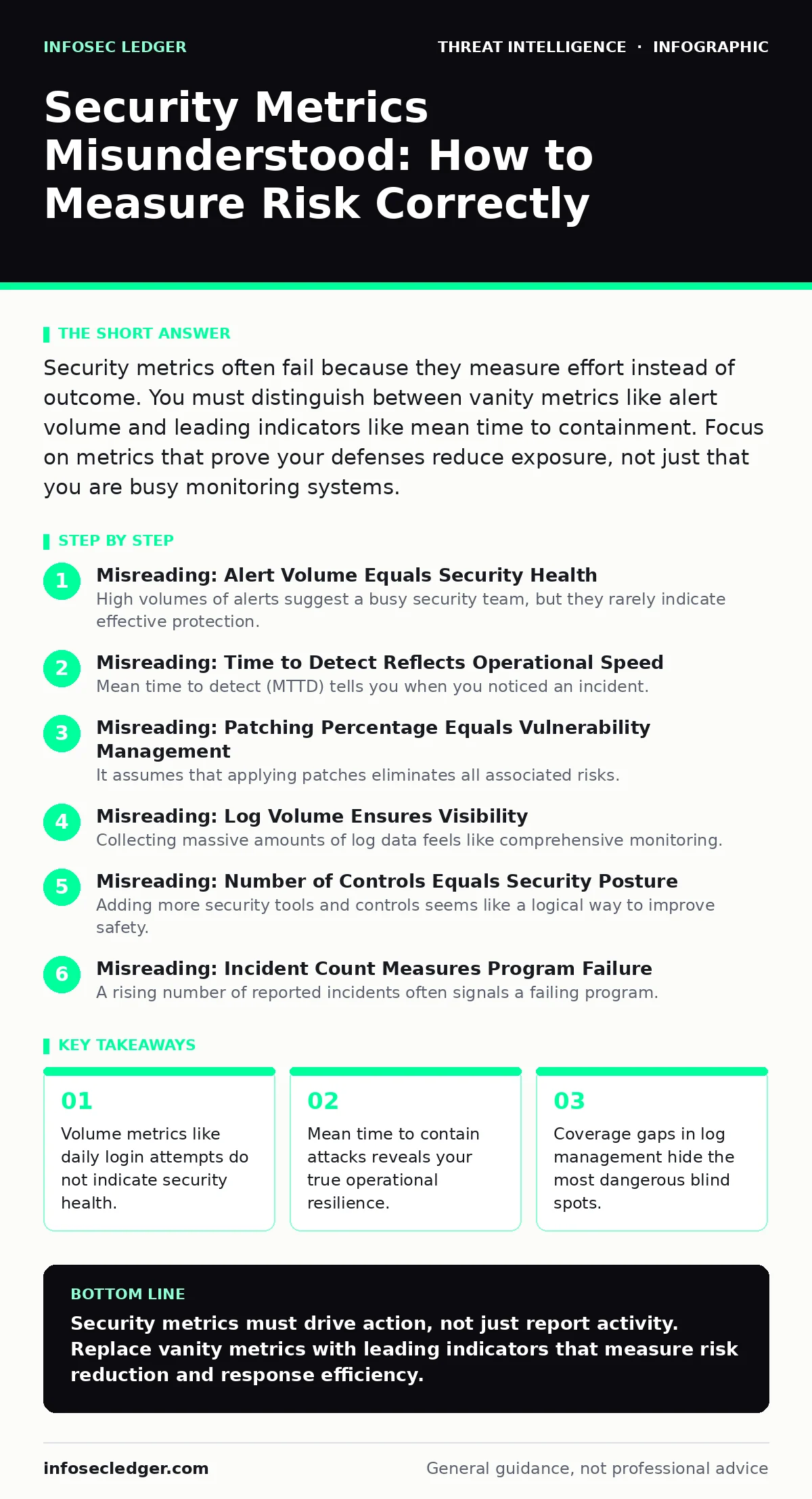
Security metrics often fail because they measure effort instead of outcome. You must distinguish between vanity metrics like alert volume and leading indicators like mean time to containment. Focus on metrics that prove your defenses reduce exposure, not just that you are busy monitoring systems.
Misreading: Alert Volume Equals Security Health
High volumes of alerts suggest a busy security team, but they rarely indicate effective protection. You might receive thousands of notifications daily while critical threats slip through unnoticed. This phenomenon, known as alert fatigue, causes analysts to ignore genuine warnings because the signal-to-noise ratio is too poor. Tracking alert counts rewards quantity over quality. It encourages tuning out low-risk noise rather than refining detection logic. You gain no insight into whether an attack succeeded or failed. The metric measures your tool’s sensitivity, not your organization’s safety.
Track the rate of false positives specifically. A lower total volume with higher precision indicates better detection engineering. You want fewer, more accurate signals. This shifts focus from processing noise to acting on genuine threats.
Misreading: Time to Detect Reflects Operational Speed
Mean time to detect (MTTD) tells you when you noticed an incident. It does not tell you how fast you stopped it. A short detection time is meaningless if your response process takes days. Imagine spotting a broken window in seconds but leaving it open for a week. The damage occurs during the response phase, not the detection phase. Focusing solely on detection creates a false sense of urgency. It ignores the slower, harder work of containment and eradication. You might detect an intrusion quickly but lack the authority to isolate the affected system.
Correct reading: Prioritize mean time to contain (MTTC). This measures the duration from first detection to full neutralization of the threat. MTTC combines detection speed with response efficiency. It reflects your actual operational resilience. Review incident post-mortems to identify bottlenecks in containment. Reduce MTTC by automating isolation steps and clarifying escalation paths. This metric drives real risk reduction.
Misreading: Patching Percentage Equals Vulnerability Management
It assumes that applying patches eliminates all associated risks. This view ignores zero-day vulnerabilities, which have no available patches. It also ignores misconfigurations that leave systems exposed despite being fully updated. It only means you installed the latest software updates. Attackers often exploit logic flaws or default settings that patches do not address. You may feel secure while remaining vulnerable to configuration errors.
Correct reading: Measure the time between public disclosure of a vulnerability and your remediation. This includes patches, configuration changes, and compensating controls. Track the number of systems with known critical exposures. Use network scanning to verify that exposures are closed. This approach covers both patched and unpatched risks. It aligns your efforts with actual attacker behavior.
Misreading: Log Volume Ensures Visibility
Collecting massive amounts of log data feels like comprehensive monitoring. It often results in storage costs without actionable insights. You might store terabytes of data that never get analyzed. This is not visibility; it is data hoarding. Effective security requires structured, normalized logs from critical assets. Without proper log management, you cannot correlate events across different systems. You miss the broader attack narrative. High volume without context hides the needle in the haystack. You waste resources storing irrelevant data while missing key indicators of compromise.
Correct reading: Measure the coverage of critical assets and the completeness of log fields. Ensure logs include user identities, source IPs, and action types. Verify that logs are forwarded to a central repository reliably. This ensures you have the necessary data for threat hunting. Quality and completeness matter more than raw volume.
Misreading: Number of Controls Equals Security Posture
Adding more security tools and controls seems like a logical way to improve safety. Each new firewall rule or policy feels like progress. This leads to control sprawl, where overlapping tools create complexity without added value. You might have 20 layers of defense that all fail in the same way. This metric measures procurement success, not security effectiveness. It ignores how well controls interact and cover each other. A single weak link can bypass all other controls. You build a wide but shallow defense.
Correct reading: Map controls to specific threats and attack paths. Use frameworks like the Pyramid of Pain to prioritize controls that increase attacker effort. Measure the reduction in attack surface after implementing each control. Verify that controls are tested regularly. Focus on depth and resilience rather than breadth. This ensures your defenses are robust against specific techniques.
See also: Why is anonymization a challenge of cybersecurity for your data · Detecting AI Content: Practical Filters and Delegation for Small Teams
Misreading: Incident Count Measures Program Failure
A rising number of reported incidents often signals a failing program. It can also indicate improved reporting and detection. If you detect more incidents, your monitoring is working better. You are finding problems that were previously hidden. Suppressing reports to keep numbers low creates a dangerous illusion of safety. It prevents learning from near-misses and minor breaches. You lose the opportunity to improve defenses based on real-world data. The goal is not zero incidents but continuous improvement.
Correct reading: Track the trend of incident severity and impact. Analyze the root causes of each incident. Identify patterns in attack vectors. Use this data to adjust your defenses. Celebrate increased detection as a sign of maturity. Focus on reducing the impact of incidents over time. This turns incidents into valuable intelligence.
Misreading: Compliance Equals Security
Passing an audit proves you meet specific regulatory requirements. It does not prove you are secure against modern threats. Auditors check for the presence of controls, not their effectiveness. You might have all required policies but never test them. Compliance is a static snapshot, while threats are dynamic. Relying on compliance creates a false sense of security. You may ignore emerging risks that fall outside audit scope. This leaves you vulnerable to novel attack techniques.
Correct reading: Use compliance as a baseline, not a ceiling. Supplement audits with red team exercises and threat hunting. Measure how well your defenses handle specific attack scenarios. Track the time to identify and respond to simulated attacks. This bridges the gap between policy and practice. It ensures your security adapts to real-world conditions.
Key takeaways
- Volume metrics like daily login attempts do not indicate security health.
- Mean time to contain attacks reveals your true operational resilience.
- Coverage gaps in log management hide the most dangerous blind spots.
Security metrics must drive action, not just report activity. Replace vanity metrics with leading indicators that measure risk reduction and response efficiency.
Frequently asked questions
What is the difference between leading and lagging security metrics?
Lagging metrics report past events, like breach counts. Leading metrics predict future risk, like patching speed or detection coverage. Focus on leading metrics to prevent incidents.
How often should I review my security metrics?
Review operational metrics daily or weekly. Review strategic metrics monthly or quarterly. Regular reviews ensure you catch trends early and adjust defenses promptly.
Can small teams use these metrics effectively?
Yes. Small teams should focus on fewer, high-impact metrics. Prioritize MTTC, coverage, and patching speed. Avoid complex dashboards that require excessive maintenance.
Do I need expensive tools to track these metrics?
No. Many metrics can be tracked with existing SIEM or log management tools. Focus on data quality and consistency. Custom scripts can calculate many key indicators without new software.
How this guide was produced: written by the InfoSec Ledger editorial team with AI assistance, checked against the public references listed below, and reviewed when the facts change. See our editorial policy or report an error.