Intelligence Cycle Steps: How to Turn Data Into Actionable Security Insights
Most organizations fail not because they lack data, but because they skip the analysis phase and treat raw logs as finished intelligence.
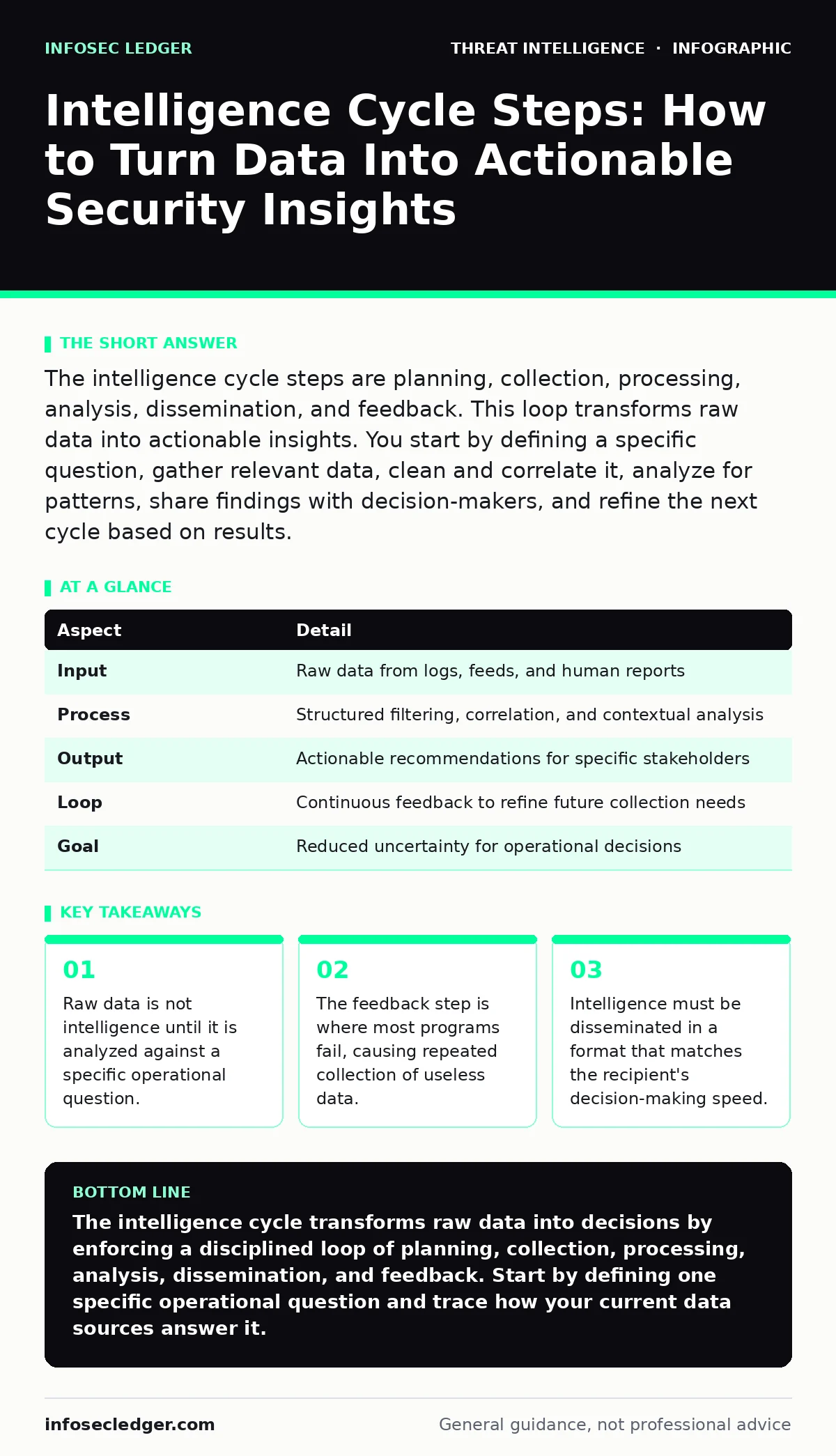
The intelligence cycle steps are planning, collection, processing, analysis, dissemination, and feedback. This loop transforms raw data into actionable insights. You start by defining a specific question, gather relevant data, clean and correlate it, analyze for patterns, share findings with decision-makers, and refine the next cycle based on results.
The Mechanics of Sense and Perception
Imagine a detective arriving at a scene. The detective does not photograph every blade of grass. The detective looks for footprints that match the suspect’s shoe size. The intelligence cycle works the same way. It is a structured method for turning noise into signal.
The intelligence cycle is a continuous process of gathering, analyzing, and sharing information to support decision-making. It prevents you from reacting to every alert with equal panic. Without this cycle, you are drowning in data without direction.
| Aspect | Detail |
|---|---|
| Input | Raw data from logs, feeds, and human reports |
| Process | Structured filtering, correlation, and contextual analysis |
| Output | Actionable recommendations for specific stakeholders |
| Loop | Continuous feedback to refine future collection needs |
| Goal | Reduced uncertainty for operational decisions |
The cycle begins with a question. You cannot answer a question you have not asked. If you ask "What is happening?", you get a flood of irrelevant noise. If you ask "Is our email gateway being targeted by phishing?", you get a manageable set of indicators. The precision of your initial question dictates the quality of your final insight.
Intelligence Cycle Steps Explained
People type "intelligence cycle steps" to understand the workflow. The standard model contains 6 distinct phases that repeat continuously. Each phase has a specific output that becomes the input for the next. Skipping a phase creates blind spots that attackers exploit.
- Planning and Direction: You define what you need to know. This step sets the priority. You identify the gap in your knowledge. You determine the required resolution and timeframe.
- Collection: You gather data from approved sources. This includes internal logs, external threat feeds, and open-source information. You collect only what serves the planning phase.
- Processing: You convert raw data into a usable format. You normalize timestamps, translate languages, and remove duplicates. You structure the data for analysis tools.
- Analysis: You evaluate the processed data against the original question. You look for patterns, anomalies, and causal links. You apply context to determine significance.
- Dissemination: You deliver the findings to the right people. You format the output for the recipient. A board member needs a summary. An engineer needs technical details.
- Feedback: You evaluate the utility of the intelligence. Did it help the decision? Was it accurate? You use this evaluation to adjust the next planning phase.
The Hidden Cost of Poor Planning
Most security teams jump straight to collection. They install sensors everywhere. They subscribe to every threat feed. This approach fails because it lacks direction. Collecting everything is not the same as collecting what matters.
When you collect without a plan, you create analysis paralysis. Your team spends hours filtering noise instead of finding threats. This delays response times. It burns out your analysts. The cost is not just money; it is missed detection windows.
Suppose your organization receives 10,000 alerts daily. Without a specific planning question, your team investigates random samples. They find nothing significant. An attacker is slowly moving laterally in your network. They remain undetected because your collection efforts were scattered. A focused plan would have prioritized internal lateral movement indicators.
Processing and Analysis: Where Value Is Created
Raw data has little value. A single IP address is just a number. A single login failure is just an event. Value emerges when you correlate multiple data points. This is the core of the analysis phase.
You must contextualize the data. Is that IP address known malicious? Is that login failure part of a brute-force pattern? Is it coming from an unusual geographic location for that user? Context turns data into intelligence.
This phase requires access to historical baselines. You need to know what "normal" looks like for your environment. Without a baseline, you cannot identify anomalies. This is why log management is a prerequisite for effective analysis. You cannot analyze what you do not retain or structure correctly.
Dissemination and The Feedback Loop
Intelligence is useless if it sits in a report. It must reach the person who can act on it. Dissemination is not just sending an email. It is packaging the insight for the consumer.
Different stakeholders need different formats. Executives need risk summaries. Incident responders need technical indicators. Developers need code snippets or configuration changes. Tailoring the message ensures it is used.
The feedback phase is often ignored. This is a critical error. If you do not ask users if the intelligence helped, you cannot improve. You will continue producing reports no one reads. You will continue collecting data that does not matter.
Feedback closes the loop. It informs the next planning phase. If a report was too technical, you simplify it next time. If a data source was inaccurate, you drop it. This iterative improvement is what separates a static program from a living intelligence function.
See also: Pyramid of Pain: Why Attacker Indicators Fail to Stop Threats · How Detection Engineering Works: From Data to Alert
Common Misconceptions About The Cycle
Many organizations misunderstand how the cycle works. These misconceptions lead to wasted resources and false confidence. Recognizing these errors helps you build a more effective program.
Misconception 1: The cycle is linear.
The cycle is not a straight line. It is a loop. Feedback immediately influences planning. Analysis may reveal a need for more collection. You must allow for non-linear movement between phases.
Misconception 2: More data equals better intelligence.
More data increases noise. It slows down analysis. Quality trumps quantity. A single high-fidelity indicator is more valuable than thousands of low-confidence alerts.
Misconception 3: Intelligence is only for external threats.
Internal threats are often more damaging. The cycle applies to insider risk, configuration drift, and compliance gaps. You must plan for internal questions as well as external ones.
Integrating Frameworks and Standards
You do not need to build your cycle from scratch. Established frameworks provide structure. The MITRE ATT&CK framework offers a taxonomy of adversary behavior. You can use it to guide your planning and analysis phases.
By mapping your data to ATT&CK techniques, you ensure comprehensive coverage. You identify gaps in your detection capabilities. You can measure your progress over time. This aligns with the concept of security metrics. You need to measure what you do not know.
Collaboration enhances the cycle. Information Sharing and Analysis Centers (ISACs) allow industries to share threat data. Participating in these groups improves your collection phase. You gain access to peer insights without collecting them yourself.
What To Do Next
Start by auditing your current process. Do you have a clear planning phase? Are you collecting data without questions? Are you sharing insights with the right people? Identify the weakest link in your cycle.
Focus on improving that link. If planning is weak, define specific questions for your next month. If dissemination is weak, interview your stakeholders about their needs. Small improvements in each phase compound over time.
Do not try to fix the entire cycle at once. Pick one phase. Implement a change. Measure the result. Use the feedback to plan the next change. This iterative approach builds a sustainable intelligence function.
Key takeaways
- Raw data is not intelligence until it is analyzed against a specific operational question.
- The feedback step is where most programs fail, causing repeated collection of useless data.
- Intelligence must be disseminated in a format that matches the recipient's decision-making speed.
The intelligence cycle transforms raw data into decisions by enforcing a disciplined loop of planning, collection, processing, analysis, dissemination, and feedback. Start by defining one specific operational question and trace how your current data sources answer it.
Frequently asked questions
How long does one cycle take?
The duration varies by urgency. Critical incidents may cycle in minutes. Strategic assessments may take months. The speed depends on the required resolution and available resources.
Can automation replace the analysis phase?
No. Automation can process and correlate data. It cannot apply human context or intuition. Analysis requires judgment to distinguish between noise and significant threat activity.
Do small teams need a formal cycle?
Yes. Even informal teams benefit from structure. A formal cycle prevents ad-hoc reactions. It ensures that limited resources are focused on the most relevant threats.
How do I measure the success of my cycle?
Measure reduction in uncertainty. Track how often intelligence leads to actionable changes. Monitor the time between detection and response. These metrics indicate operational value.
How this guide was produced: written by the InfoSec Ledger editorial team with AI assistance, checked against the public references listed below, and reviewed when the facts change. See our editorial policy or report an error.