Synthetic Media Meaning: How AI Fakes Reality and How to Spot It
Synthetic media uses algorithms to generate realistic audio and video, creating a verification crisis that challenges your ability to trust digital evidence.
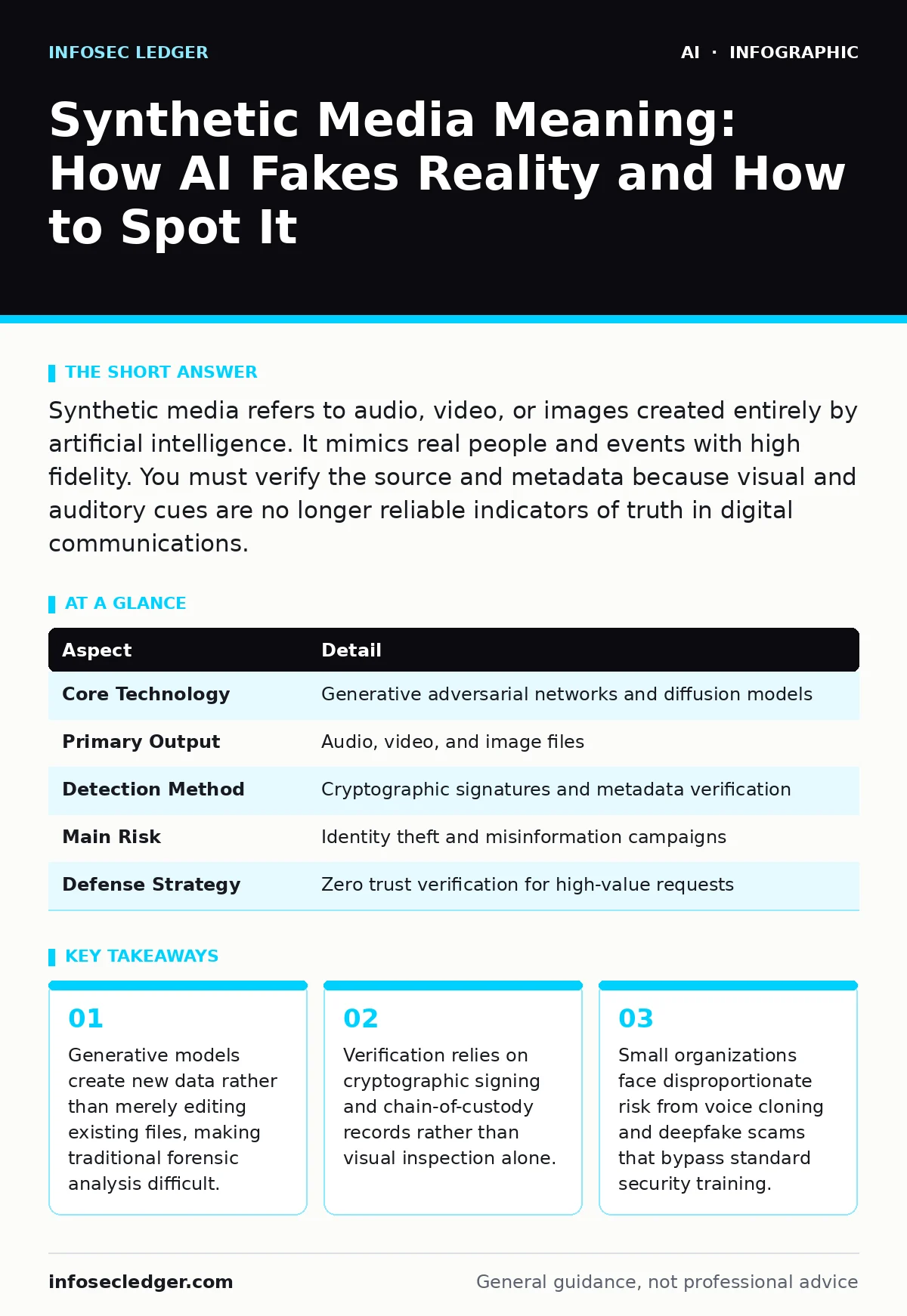
Synthetic media refers to audio, video, or images created entirely by artificial intelligence. It mimics real people and events with high fidelity. You must verify the source and metadata because visual and auditory cues are no longer reliable indicators of truth in digital communications.
Everyday Analogy: The Digital Camouflage
Imagine a skilled forger who does not just copy a painting but understands the chemical composition of the original pigments. They can create new canvases that match the aging patterns, brush strokes, and texture of a masterpiece. Synthetic media operates on this principle. It does not simply cut and paste pixels. It learns the underlying rules of human appearance and sound to generate content that looks and feels authentic. The forger creates something new that passes as old.
What Synthetic Media Actually Means
Synthetic media meaning centers on content generated by machine learning models. These systems analyze vast datasets of human speech, facial expressions, and movements. They then reconstruct this data to create new instances that did not exist before. This includes deepfakes, which swap faces in video, and voice cloning, which replicates speech patterns. The output is indistinguishable from reality to the human eye and ear. You cannot rely on imperfections or glitches to identify the fake.
| Aspect | Detail |
|---|---|
| Core Technology | Generative adversarial networks and diffusion models |
| Primary Output | Audio, video, and image files |
| Detection Method | Cryptographic signatures and metadata verification |
| Main Risk | Identity theft and misinformation campaigns |
| Defense Strategy | Zero trust verification for high-value requests |
How the Technology Works
The process begins with data ingestion. The model consumes thousands of hours of video or audio to learn statistical patterns. It maps how light interacts with skin, how vocal cords vibrate, and how eyes blink. When you request a generation, the model synthesizes pixels or sound waves that fit these learned patterns. It does not retrieve a stored clip. It calculates the most probable next frame or audio sample. This calculation happens in milliseconds. The result is coherent, continuous, and highly realistic.
Who It Affects and Why
Every organization that communicates digitally faces exposure. Attackers use synthetic media to impersonate executives, support staff, or customers. They bypass two-factor authentication by mimicking a trusted voice on a phone call. They create fake news feeds to manipulate public opinion or stock prices. Small teams are vulnerable because they often lack dedicated security operations centers. A single convincing voice message can authorize a fraudulent wire transfer. The cost of verification rises for everyone. Trust becomes a liability rather than an asset.
Common Misconceptions About Detection
Many assume that watermarks will solve the problem. Adversaries can remove or alter watermarks with equal ease. Others believe that AI content detection tools are infallible. These classifiers are prone to false positives and false negatives. They struggle with compressed video or edited audio. A more dangerous belief is that only celebrities are at risk. Anyone with a few minutes of public video or audio can be cloned. Your employees, your customers, and you are all potential targets. The barrier to entry for creating convincing fakes has dropped significantly.
See also: Securing AI Agents With Information-Flow Control: The Silent Boundary · Access Controls for AI Agents: Secure Autonomous Systems
Practical Defense Strategies
You must shift from detection to verification. Implement out-of-band verification for any financial request or sensitive data transfer. If someone calls to change a bank account, verify the request via a separate channel you control. Use cryptographic signing for official communications. This proves the origin of the message. Train staff to recognize social engineering tactics that use urgency. Do not let a fake video override established security protocols. Review your AI usage policies at work to ensure clear guidelines on generating and sharing synthetic content.
The Hidden Costs of Trust
The broader impact extends beyond immediate fraud. Organizations must invest in new verification infrastructure. This includes digital identity solutions and secure communication channels. Legal liability increases when synthetic media is used to defame or defraud. You may need to prove the authenticity of your own communications. This creates a hidden tax on digital interaction. Every video conference or press release requires additional effort to prove its legitimacy. The burden of proof shifts entirely to the sender.
Related Security Considerations
Understanding synthetic media requires looking at the broader AI threat model. Attackers often pair these fakes with AI-generated phishing emails to create multi-stage attacks. Your defenses must account for this combination. Meanwhile, defenders use machine learning for fraud detection to identify anomalous behavior patterns. This cat-and-mouse game drives rapid innovation.
You should also consider AI bias in the models that generate or detect this content. Biased training data can lead to inaccurate detections, disproportionately affecting certain groups. Fine-tuning detection models helps but requires careful oversight. For internal tools, securing AI agents ensures that automated systems do not inadvertently amplify synthetic content.
Key takeaways
- Generative models create new data rather than merely editing existing files, making traditional forensic analysis difficult.
- Verification relies on cryptographic signing and chain-of-custody records rather than visual inspection alone.
- Small organizations face disproportionate risk from voice cloning and deepfake scams that bypass standard security training.
Frequently asked questions
Can I trust a video call from my boss?
You cannot trust the video alone. Verify the request through a separate communication channel or in person, especially if it involves financial actions or sensitive data.
Are there free tools to detect deepfakes?
Some tools exist, but they are not reliable for critical decisions. They often produce false results. Use cryptographic verification and procedural checks instead of relying solely on detection software.
Does compression make deepfakes easier to spot?
No. Compression often removes the subtle artifacts that detection tools look for. It can make synthetic media appear more natural by smoothing out digital inconsistencies, making manual inspection harder.
How do I protect my voice from cloning?
Limit the amount of high-quality audio you share publicly. Use unique verbal passwords for sensitive accounts. Assume your voice can be cloned and rely on multi-factor authentication that does not depend on voice recognition.
How this guide was produced: written by the InfoSec Ledger editorial team with AI assistance, checked against the public references listed below, and reviewed when the facts change. See our editorial policy or report an error.