
AI Chat Links in Search Results and How to Prevent Them
Public chat transcripts often leak into search engine indexes because automated web scrapers index shared conversation URLs immediately.
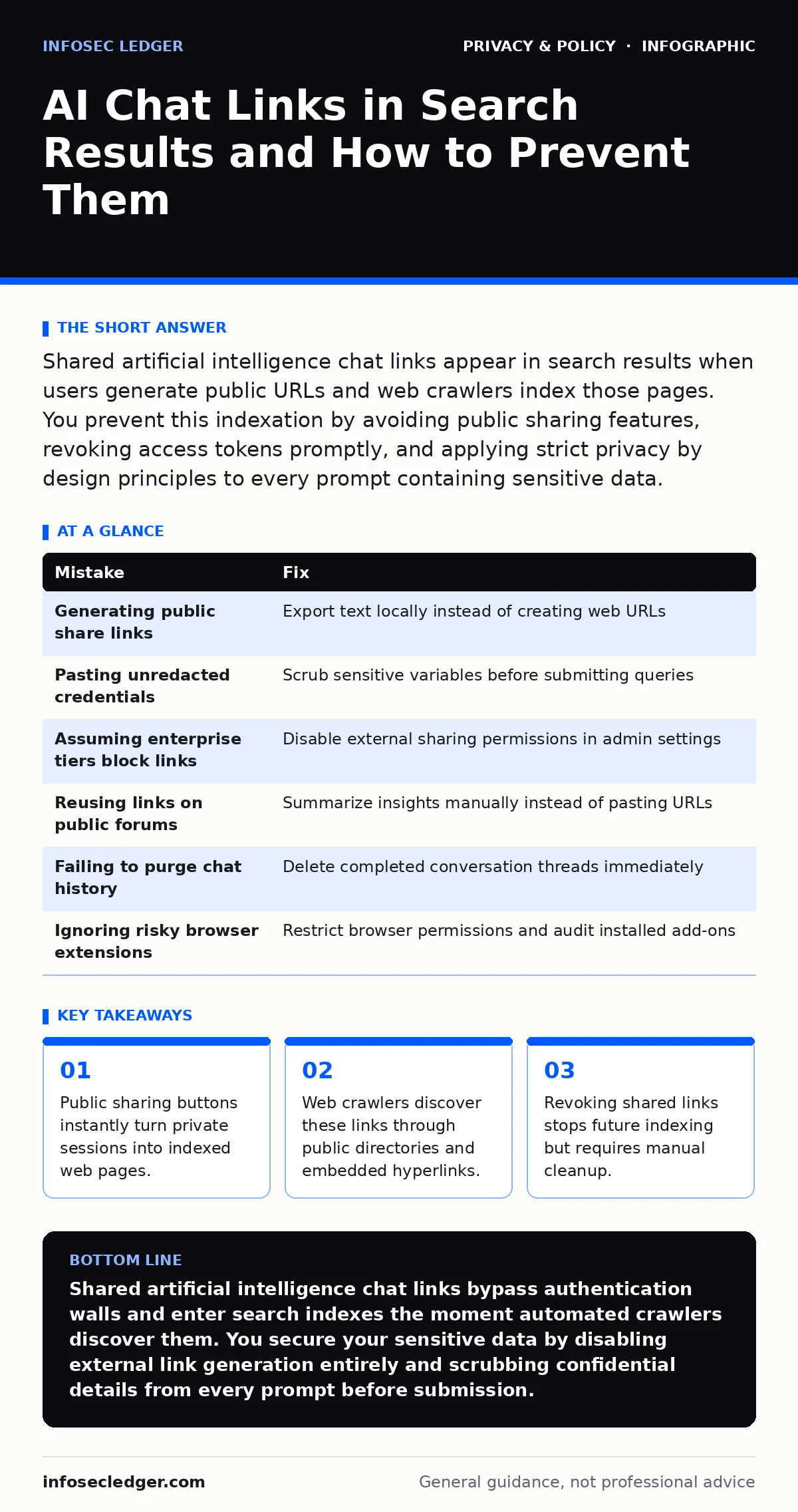
Shared artificial intelligence chat links appear in search results when users generate public URLs and web crawlers index those pages. You prevent this indexation by avoiding public sharing features, revoking access tokens promptly, and applying strict privacy by design principles to every prompt containing sensitive data.
Mistake 1: Generating public share links for quick collaboration
Sharing conversation transcripts via native platform buttons creates external web pages that bypass standard authentication walls entirely. Artificial intelligence platforms generate these unique Uniform Resource Locators to let peers view discussions without logging into an account, which inadvertently opens the door for automated indexers.
Why it hurts: Search engine crawlers traverse the web following hyperlinks and discover these unlisted pages within hours of publication. Once indexed, confidential business strategies, proprietary source code, and customer data become searchable text strings for anyone querying the wider web.
The fix: Export conversation text manually into local documents or secure internal messaging channels instead of creating web links. You eliminate external exposure entirely when team members rely on direct file transfers rather than cloud-hosted chat views.
Mistake 2: Pasting unredacted internal credentials into active sessions
Typing sensitive passwords, application programming interface keys, or personal identifiers into chat prompts creates permanent digital footprints on remote servers. Users frequently paste raw configuration files to debug software errors without stripping out proprietary secrets first.
Why it hurts: Shared chat transcripts preserve every keystroke, including hidden credentials and internal network paths. If a user subsequently generates a public link for that session, external observers and search bots gain immediate access to sensitive authentication vectors.
The fix: Scrub all sensitive variables, tokens, and names from your prompts before submitting queries to any external language model. Consistent anonymization practices ensure that even if a conversation link leaks publicly, the exposed text contains zero actionable intelligence.
Mistake 3: Assuming enterprise tiers prevent link indexing automatically
Upgrading to paid business accounts gives a false sense of security regarding web crawler behaviors across shared artifacts. Organizations often configure team workspaces assuming default policies block external search indexing on every generated artifact.
Why it hurts: Enterprise controls typically govern data retention and model training rather than the public accessibility of explicitly shared URLs. When an employee clicks the external link button, the resulting web page remains reachable by any automated harvester traversing public internet space.
The fix: Audit your organization platform settings regularly to disable external sharing permissions at the administrator level. You protect institutional data streams only when platform-wide policies restrict link generation entirely across all user accounts.
Mistake 4: Reusing conversation links across public forum posts
Dropping generated chat URLs into open community boards, social media threads, or public ticketing systems broadcasts your session addresses to the world. Indexing bots monitor these high-traffic public domains constantly to harvest fresh hyperlinks.
Why it hurts: Search engines prioritize links found on frequently visited public forums, accelerating the rate at which your private chat transcripts enter search engine indexes. A single forum post can cause a private conversation to rank prominently for related keyword queries.
The fix: Share technical insights by summarizing key takeaways in your own words rather than pasting raw session URLs. You maintain complete control over your digital footprint when avoiding direct hyperlinks to cloud-hosted workspaces.
Mistake 5: Failing to purge chat history after project completion
Leaving historical conversation threads active in your account dashboard leaves a lingering trail of sensitive data vulnerable to future platform changes. Interface updates or feature modifications can inadvertently alter the visibility status of older stored sessions.
Why it hurts: Dormant chats sitting in active user profiles represent forgotten risks that accumulate silently over long operational periods. If platform permissions shift or a user accidentally toggles a sharing setting later, years of archived data become instantly searchable.
The fix: Delete completed conversation threads immediately from your account history once the specific task concludes. Establishing a routine deletion habit ensures stale data does not linger where software updates might expose it.
See also: NIST AI Risk Management Framework: How to secure machine learning
Mistake 6: Ignoring browser extensions that leak active session URLs
Installing third-party browser add-ons designed to enhance artificial intelligence interfaces often grants those extensions broad permission to read active tab addresses. Certain extensions aggregate user links into public repositories to train auxiliary recommendation engines.
Why it hurts: Background extensions can harvest generated chat URLs automatically and transmit them to external analytics servers without visible notification. These harvested URLs frequently land in public datasets that feed search engine crawlers.
The fix: Restrict your browser environment strictly and review app permission management settings for every installed extension. You prevent unauthorized data harvesting when limiting browser add-ons to trusted, open-source utilities operated in private browsing mode.
| Mistake | Fix |
|---|---|
| Generating public share links | Export text locally instead of creating web URLs |
| Pasting unredacted credentials | Scrub sensitive variables before submitting queries |
| Assuming enterprise tiers block links | Disable external sharing permissions in admin settings |
| Reusing links on public forums | Summarize insights manually instead of pasting URLs |
| Failing to purge chat history | Delete completed conversation threads immediately |
| Ignoring risky browser extensions | Restrict browser permissions and audit installed add-ons |
Key takeaways
- Public sharing buttons instantly turn private sessions into indexed web pages.
- Web crawlers discover these links through public directories and embedded hyperlinks.
- Revoking shared links stops future indexing but requires manual cleanup.
Shared artificial intelligence chat links bypass authentication walls and enter search indexes the moment automated crawlers discover them. You secure your sensitive data by disabling external link generation entirely and scrubbing confidential details from every prompt before submission.
Frequently asked questions
Can search engines find unlisted AI chat links if nobody shares them publicly?
Web crawlers rarely discover unlisted links unless the Uniform Resource Locator is published somewhere accessible, but guessing algorithms and browser extensions can still expose them.
Does deleting a shared chat link remove it from search engine results instantly?
Deleting the chat stops the source page from loading, but search engines will continue displaying the cached version until their web crawlers revisit and re-index the broken address.
Are corporate artificial intelligence tools safer against accidental link indexing?
Corporate tools offer better administrative controls over data retention, but they still permit external link creation unless administrators explicitly disable that feature globally.
How can you check if your past chat links have been indexed by search engines?
You search for unique phrases or specific text strings from your past conversations inside major search engines to verify whether any transcripts appear publicly.
How this guide was produced: written by the InfoSec Ledger editorial team with AI assistance, checked against the public references listed below, and reviewed when the facts change. See our editorial policy or report an error.