Deepfake fraud definition and defense against synthetic identity scams
Synthetic media generation allows attackers to clone human voices and faces using only short audio and video samples found online.
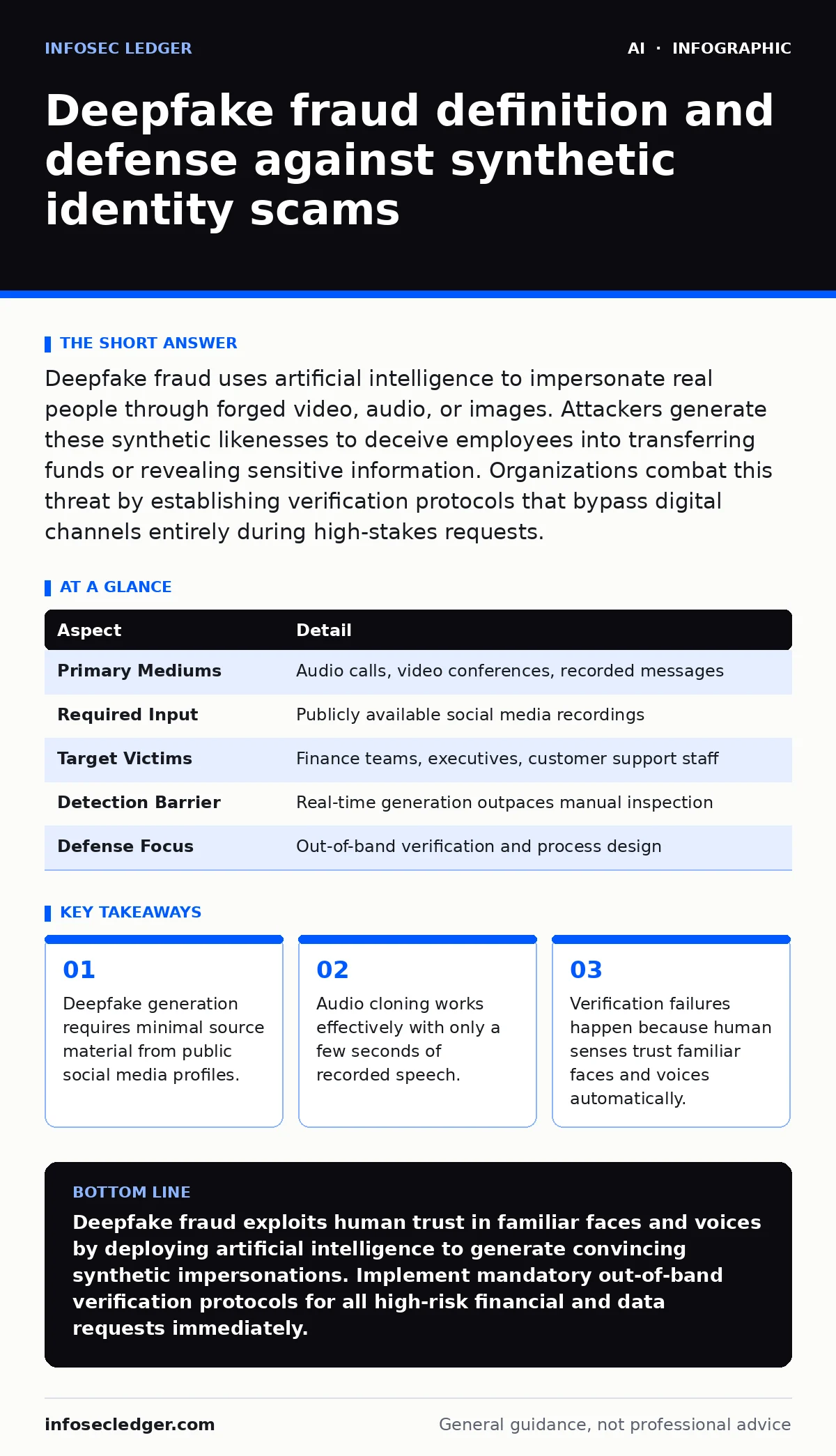
Deepfake fraud uses artificial intelligence to impersonate real people through forged video, audio, or images. Attackers generate these synthetic likenesses to deceive employees into transferring funds or revealing sensitive information. Organizations combat this threat by establishing verification protocols that bypass digital channels entirely during high-stakes requests.
How synthetic audio and video deceive human perception
Deepfake fraud relies on generative artificial intelligence, a branch of computer science that creates new media based on patterns learned from existing data. Attackers feed hours of public speeches, interviews, or video clips into neural networks to map facial movements and vocal inflections. Synthetic media production tools then generate entirely new audio and video streams where the target appears to say or do things they never actually did.
Human evolution shaped brains to trust immediate visual and auditory cues from trusted peers. When a manager sees a familiar face on a video call or hears a known voice on a phone line, cognitive biases override skepticism. Attackers exploit this biological trust shortcut. They bypass traditional security checkpoints by weaponizing the victim's own familiarity against them.
| Aspect | Detail |
|---|---|
| Primary Mediums | Audio calls, video conferences, recorded messages |
| Required Input | Publicly available social media recordings |
| Target Victims | Finance teams, executives, customer support staff |
| Detection Barrier | Real-time generation outpaces manual inspection |
| Defense Focus | Out-of-band verification and process design |
Mechanics of automated impersonation attacks
Creating a convincing digital clone starts with gathering source material from corporate websites, conference presentations, or social media posts. Machine learning algorithms analyze this data to replicate pitch, cadence, accents, and facial turgor. Once the training phase finishes, the attacker operates an interface that generates custom dialogue in real time.
Audio spoofing operates during live telephone calls or voice messaging applications. The software maps the attacker's spoken words instantly onto the acoustic profile of the targeted executive. Video deepfakes require more processing power and often rely on pre-recorded loops during virtual meetings. If challenged about poor video quality, the attacker's script blames network latency or camera malfunctions to maintain the illusion.
Who faces the highest risk of synthetic impersonation
Organizations with publicly visible leadership carry the highest exposure to targeted impersonation. Chief executive officers, chief financial officers, and founders frequently publish video interviews, keynote speeches, and podcast appearances. This public footprint provides attackers with pristine training data for voice and video cloning models.
Finance department personnel represent the primary operational target for these scams. Attackers direct requests for invoice payments, payroll changes, or emergency fund transfers toward employees who possess authorization capabilities. Customer service teams also encounter synthetic media when attackers attempt to bypass identity verification procedures using generated video feeds during remote onboarding sessions.
Common forms of digital deception
Voice cloning attacks occur most frequently because audio files demand less processing bandwidth than video streams. An attacker calls a mid-level manager using the exact voice of a trusted superior to authorize an unusual transaction or request password resets. These phone calls often feature manufactured background noise, such as airport terminals or traffic, to explain away audio artifacts.
Virtual meeting hijackings insert pre-recorded synthetic video streams into live conference software. The attacker joins a scheduled video call with the camera disabled or heavily pixelated before switching to a manipulated feed that mimics a participant. This technique allows fraudsters to observe internal team dynamics and participate in sensitive operational discussions while remaining completely disguised.
What people usually get wrong about detection
Many organizations believe that human intuition serves as an effective defense against sophisticated digital forgery. Employees assume they will instantly recognize when a colleague or vendor is not who they claim to be. In practice, high-stress situations and familiar vocal tones quickly erode healthy skepticism, causing staff to ignore subtle visual or auditory inconsistencies.
Another frequent misconception relies on the expectation that deepfakes always display obvious technical flaws. Modern generation tools reduce artifacts rapidly, eliminating the blurred edges and unnatural movements common in early experiments. Relying on visual inspection alone leaves organizations vulnerable to higher-quality forgeries that defeat casual observation entirely.
See also: Voice Cloning Scams: 6 Myths That Leave Your Business Vulnerable · Responsible AI Practices Explained: Build Safer Machine Models
Reducing exposure through process redesign
Defending against synthetic impersonation requires strict adherence to multi-step verification policies that bypass digital communication channels. When an executive requests a financial transaction or sensitive data release through a phone call or video meeting, staff must confirm the request using an independent, pre-established channel such as an internal messaging system or an in-person check.
Establishing rigid out-of-band validation rules removes the burden of real-time detection from individual employees. Organizations should implement mandatory approval thresholds that require dual authorization for any unusual fund movement, regardless of who appears to issue the command. Pair these operational boundaries with regular employee education managed through structured AI usage policies at work to clarify reporting procedures for suspicious requests.
Key takeaways
- Deepfake generation requires minimal source material from public social media profiles.
- Audio cloning works effectively with only a few seconds of recorded speech.
- Verification failures happen because human senses trust familiar faces and voices automatically.
Deepfake fraud exploits human trust in familiar faces and voices by deploying artificial intelligence to generate convincing synthetic impersonations. Implement mandatory out-of-band verification protocols for all high-risk financial and data requests immediately.
Frequently asked questions
Can standard antivirus software detect deepfake audio or video streams?
Standard antivirus software cannot detect deepfakes because synthetic media files do not contain malicious code or traditional malware signatures.
How much source material do attackers need to create a voice clone?
Attackers can generate a functional voice clone using only a few seconds of clear speech harvested from public video recordings or podcasts.
Why are video deepfakes harder to execute than audio clones?
Video deepfakes require synchronous movement mapping for facial expressions, lighting consistency, and head positioning, which demands significantly more processing power and preparation time.
What is the most reliable way to stop synthetic identity fraud?
Requiring secondary verification through an independent communication channel completely neutralizes the effectiveness of real-time audio and video impersonation.
How this guide was produced: written by the InfoSec Ledger editorial team with AI assistance, checked against the public references listed below, and reviewed when the facts change. See our editorial policy or report an error.