Voice Cloning Scams: 6 Myths That Leave Your Business Vulnerable
Synthetic audio attacks succeed not through Hollywood-quality realism, but by exploiting human trust in familiar voices and bypassing outdated verification habits.
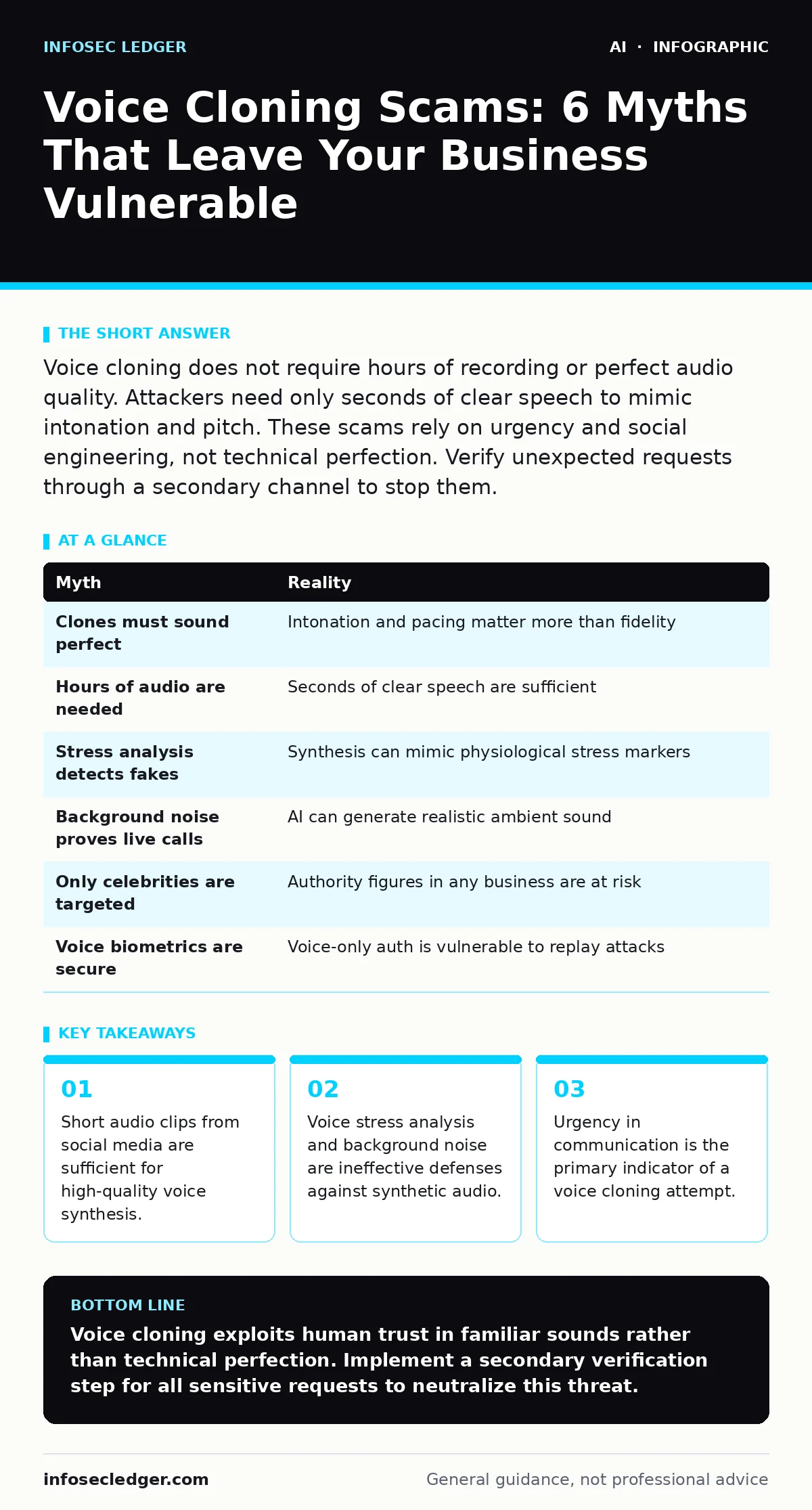
Voice cloning does not require hours of recording or perfect audio quality. Attackers need only seconds of clear speech to mimic intonation and pitch. These scams rely on urgency and social engineering, not technical perfection. Verify unexpected requests through a secondary channel to stop them.
Myth: The Voice Clone Must Sound Perfectly Realistic
Reality: You do not need to hear flawless audio to fall for a scam. Early synthetic voices sounded robotic, but current models prioritize intonation, pacing, and emotional cadence over raw fidelity. The human brain is wired to recognize rhythm and stress patterns in speech faster than it analyzes phonetic accuracy.
Attackers often add slight compression artifacts or background noise to make the audio feel more authentic. This imperfection can actually increase trust, as perfect silence is rare in real-world calls. If a caller sounds slightly distant or compressed, your brain may attribute this to a poor connection rather than synthesis.
The goal is not to fool an audio engineer but to bypass your immediate skepticism. A clone that captures the victim’s specific way of saying "uh" or pausing before a difficult word can trigger a strong sense of familiarity. This familiarity reduces the cognitive load required to process the request, making you more likely to comply without question.
Myth: You Need Hours of Recording to Clone a Voice
Reality: Modern deep learning models can generate convincing synthetic speech from less than thirty seconds of clear audio. These models analyze the spectral characteristics of the source audio to build a digital twin of the vocal tract. They do not need the full range of emotions or contexts that a professional actor would require.
Publicly available content provides ample source material. Short clips from social media videos, podcast introductions, or even conference calls are often sufficient. Attackers scrape these platforms automatically to gather training data for high-value targets. You do not need to be a public figure to be at risk; any clear audio sample posted online can be harvested.
The quality of the clone depends more on the clarity of the source than its length. A ten-second clip recorded in a quiet room with a good microphone is more dangerous than ten minutes of noisy background chatter. This means your casual voice notes or quick video updates can serve as the foundation for a sophisticated attack.
Myth: Voice Stress Analysis Detects Fake Audio
Reality: Traditional voice stress analysis measures physiological tension in the vocal cords, which creates micro-tremors in the sound wave. Synthetic audio is generated mathematically, not physiologically, so it lacks these biological markers. However, modern synthesis models can be trained to inject artificial noise or jitter to mimic these tremors.
Relying on stress detection tools is a false sense of security. These tools were designed to detect human deception, not digital fabrication. An attacker can easily manipulate the output waveform to include simulated stress indicators. The absence of stress does not prove authenticity, and the presence of stress does not prove humanity.
This misconception persists because many legacy security systems still employ these detectors. They fail to account for the generative nature of modern AI. Instead of analyzing the voice itself, you should analyze the context of the request. A legitimate emergency rarely aligns perfectly with unusual payment methods or immediate secrecy demands.
Myth: Background Noise Proves the Call Is Live
Reality: Generative adversarial networks can synthesize realistic background environments along with the voice. These models can add the sound of traffic, office chatter, or air conditioning to the audio stream. The background noise is not a recording but a generated layer that matches the acoustic profile of the speaker.
Attackers can also use real-time mixing to overlay live background audio onto the synthetic voice. This makes it difficult to distinguish between a person calling from a busy street and a synthesized voice pretending to be on a busy street. The synchronization between the voice and the background noise is often too precise to be accidental, but this detail is lost on most listeners.
Do not use ambient sound as a verification method. It is an easy variable for an attacker to control. Instead, focus on the content of the conversation. Ask for information that would not be available in a public profile or a previous conversation. This forces the attacker to rely on stolen data rather than real-time interaction.
Myth: Only Public Figures Are Targets
Reality: Small business owners and mid-level managers are frequent targets for voice cloning scams. These individuals often have authority over financial transactions, payroll, or sensitive data. Attackers prioritize targets with access over targets with fame. A cloned voice of a CFO requesting a wire transfer is far more profitable than a cloned voice of a celebrity.
The attack surface for smaller organizations is often wider due to less rigorous verification protocols. Employees may know the leadership team personally, making them more likely to trust a familiar voice. This social proximity is exploited by scammers who pose as colleagues or executives in distress.
Your visibility online does not determine your risk; your authority does. If you can approve payments or access secure systems, you are a target. Ensure that your organization has strict protocols for verifying financial requests, regardless of who appears to be making them.
See also: Securing AI Agents With Information-Flow Control: The Silent Boundary · Access Controls for AI Agents: Secure Autonomous Systems
Myth: Voice Biometrics Are Secure Authentication
Reality: Voice biometrics systems that rely solely on voice matching are vulnerable to replay attacks and synthesis. If a system accepts a voice print as proof of identity, a high-quality clone can bypass it. This is a critical failure point for any security architecture that uses voice as a single factor of authentication.
The NIST AI Risk Management Framework highlights the need for continuous monitoring and risk assessment in AI systems. Voice biometrics must be part of a multi-layered defense. Combining voice recognition with something you have, like a hardware token, or something you know, like a PIN, mitigates the risk of cloning.
Summary of Myths and Realities
| Myth | Reality |
|---|---|
| Clones must sound perfect | Intonation and pacing matter more than fidelity |
| Hours of audio are needed | Seconds of clear speech are sufficient |
| Stress analysis detects fakes | Synthesis can mimic physiological stress markers |
| Background noise proves live calls | AI can generate realistic ambient sound |
| Only celebrities are targeted | Authority figures in any business are at risk |
| Voice biometrics are secure | Voice-only auth is vulnerable to replay attacks |
Key takeaways
- Short audio clips from social media are sufficient for high-quality voice synthesis.
- Voice stress analysis and background noise are ineffective defenses against synthetic audio.
- Urgency in communication is the primary indicator of a voice cloning attempt.
- Multi-factor authentication that relies solely on voice recognition is vulnerable to replay attacks.
Voice cloning exploits human trust in familiar sounds rather than technical perfection. Implement a secondary verification step for all sensitive requests to neutralize this threat.
Frequently asked questions
Can I use AI to detect if a voice is fake?
AI detection tools are improving but are not foolproof. They can flag suspicious patterns, but attackers can adapt their synthesis techniques to evade detection. Always use a secondary verification method.
How do I verify a caller's identity?
Hang up and call the person back using a known, trusted number. Do not use the number provided by the caller. Ask a pre-arranged security question that is not publicly available.
Is my voice safe on social media?
No. Any clear audio you post can be harvested and used for training models. Limit the amount of high-quality voice data you share publicly, especially in contexts that reveal your identity or role.
What is the best defense against voice cloning?
Process changes are more effective than technology. Require multi-factor authentication for financial transactions and establish a culture of verification where employees feel safe questioning requests, even from superiors.
How this guide was produced: written by the InfoSec Ledger editorial team with AI assistance, checked against the public references listed below, and reviewed when the facts change. See our editorial policy or report an error.