
Responsible AI Practices Explained: Build Safer Machine Models
Managing software that learns requires treating algorithms like untrained interns who need clear boundaries and constant supervision.
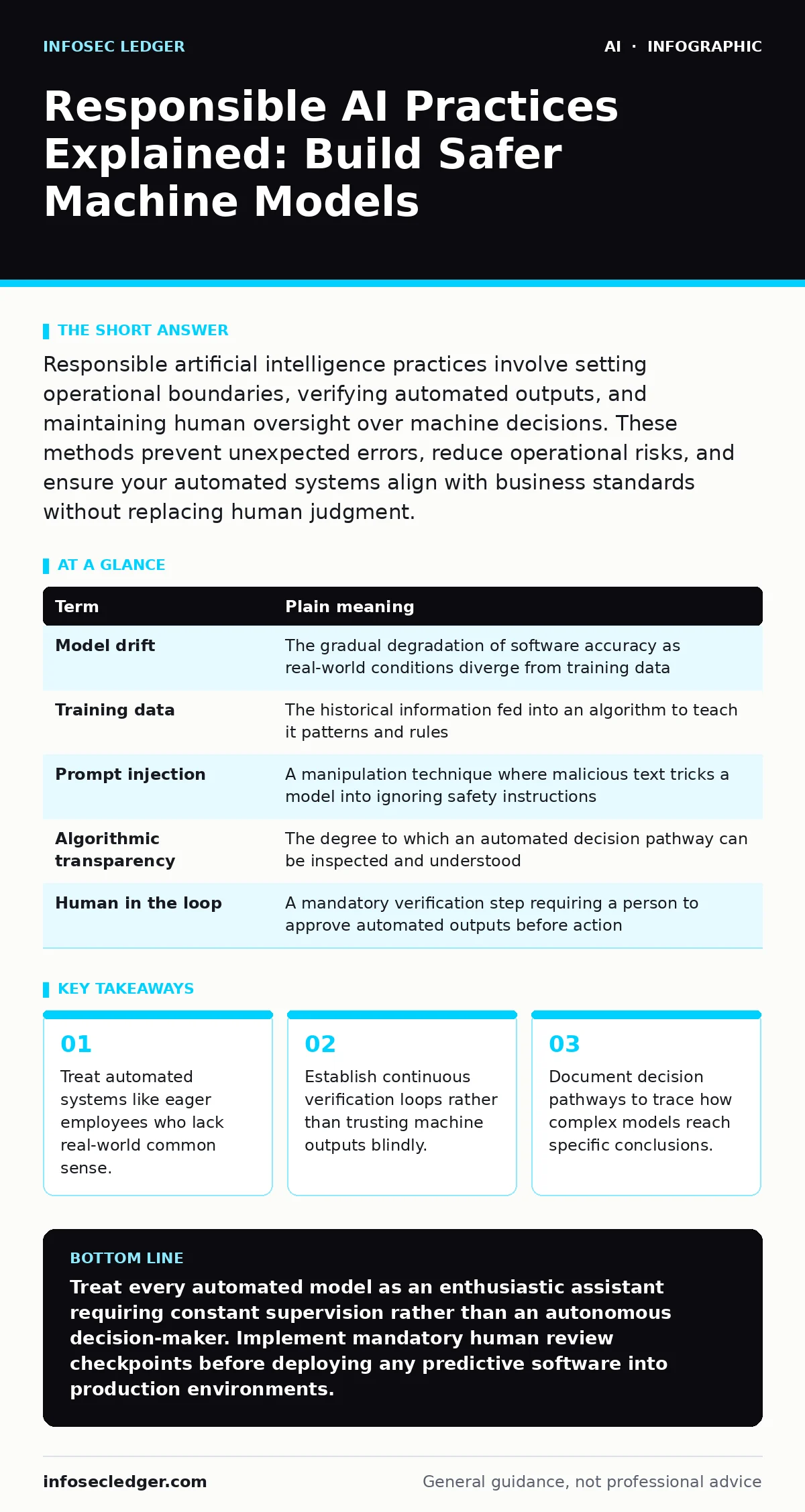
Responsible artificial intelligence practices involve setting operational boundaries, verifying automated outputs, and maintaining human oversight over machine decisions. These methods prevent unexpected errors, reduce operational risks, and ensure your automated systems align with business standards without replacing human judgment.
Why Intelligent Systems Need Supervision
Automated software models generate text, code, and predictions by spotting statistical patterns in massive datasets. Machine intelligence processes information at speeds human teams cannot match, but speed introduces distinct operational hazards. Blindly trusting automated outputs invites costly mistakes because models lack actual comprehension of the tasks they perform. You must institute strict verification protocols before deploying any predictive tool into your daily operations.
Computational models reflect the flaws and historical prejudices present in their training data. Unchecked algorithms frequently amplify hidden errors, leading to skewed outcomes that damage customer trust. Recognizing these architectural limitations helps you deploy predictive tools safely. Establishing operational guardrails prevents algorithms from making autonomous choices that bypass human review and accountability standards.
The Intern Analogy for Automated Models
Imagine hiring an incredibly well-read intern who memorized every book in the library but never stepped foot outside. This eager worker can draft a report in seconds, yet possesses zero intuition about office politics or physical reality. Trusting that intern to publish company communications without a final review creates severe operational risks. Automated software functions exactly like this inexperienced worker, possessing vast computational recall without contextual judgment.
Guiding an intelligent algorithm requires the exact management techniques you would use for a brilliant newcomer. You must assign specific tasks, check intermediate steps, and prohibit the worker from handling sensitive decisions alone. Clear instructions and constant supervision transform raw computational power into a reliable asset. Setting explicit operational limits prevents the intern from guessing answers when facing unfamiliar scenarios.
Mapping AI Bias and Blind Spots
Systemic unfairness creeps into automated workflows when training data contains historical skews or unrepresentative samples. AI bias occurs when algorithms favor certain demographic groups or outcomes because the underlying data reflects past societal inequalities. Detecting these distorted patterns demands active auditing of your model inputs long before deployment. Ignoring data imbalances turns your software into an automated engine of discrimination that alienates customers.
Hidden feedback loops worsen these distortions over time by feeding model outputs back into subsequent training cycles. Suppose your software screens job applicants based on past hiring successes, accidentally penalizing non-traditional candidates. Fixing this issue requires injecting diverse examples and manually overriding automated rejections during initial testing phases. Constant vigilance regarding data provenance stops your systems from hardening accidental prejudices into permanent policies.
Adopting Structured Risk Frameworks
Standardized governance structures provide a repeatable method for identifying, measuring, and managing automated system failures. The NIST AI Risk Management Framework offers a practical blueprint for mapping vulnerabilities across the entire lifecycle of a predictive model. Adopting these structured guidelines helps your organization categorize threats ranging from data poisoning to unexpected model drift. Structured governance replaces guesswork with documented safety checkpoints that satisfy regulatory expectations.
Formal risk management requires assigning clear ownership for every automated tool deployed within your enterprise. Technical teams often focus purely on performance metrics while ignoring ethical boundaries or operational consequences. Establishing cross-functional review boards ensures that legal, security, and operational perspectives shape your deployment strategies. Balancing speed with structured oversight prevents minor software glitches from cascading into major business crises.
Defining Core Concepts
Clear terminology helps technical and non-technical teams communicate effectively about automated risks and responsibilities.
| Term | Plain meaning |
|---|---|
| Model drift | The gradual degradation of software accuracy as real-world conditions diverge from training data |
| Training data | The historical information fed into an algorithm to teach it patterns and rules |
| Prompt injection | A manipulation technique where malicious text tricks a model into ignoring safety instructions |
| Algorithmic transparency | The degree to which an automated decision pathway can be inspected and understood |
| Human in the loop | A mandatory verification step requiring a person to approve automated outputs before action |
See also: What causes generative AI hallucinations and how to stop them · NIST AI Risk Management Framework: How to secure machine learning
Three Steps to Build Safer Workflows
Taking practical action requires immediate changes to how your organization evaluates and deploys software tools. You can dramatically improve your security posture by implementing three foundational controls today.
- Inventory every automated tool currently operating within your business environment to map potential blind spots.
- Mandate human review stages for any software output that impacts customer data or financial transactions.
- Establish a feedback mechanism for employees to report strange or biased model behaviors immediately.
Edge cases frequently break automated systems because real-world inputs rarely match clean laboratory test conditions. Model drift occurs silently as customer habits shift, causing algorithms to generate increasingly inaccurate predictions without throwing obvious error codes. Maintaining manual checkpoints protects your daily operations against these invisible failures.
Hidden Costs of Unchecked Automation
Deploying advanced algorithms without proper oversight introduces significant financial and reputational liabilities that outweigh initial labor savings. Fixing a corrupted automated workflow often costs far more than the human labor required to perform the task manually. Reputation damage resulting from biased automated decisions can destroy customer loyalty overnight. Measuring the true cost of automation must account for potential failure recovery expenses and legal exposure.
Security teams must treat automated code generation with the same caution applied to external software libraries. Software models can inadvertently memorize proprietary source code or confidential customer records present in training sets. Guarding your intellectual property requires strict boundaries around what data enters your training pipelines.
Key takeaways
- Treat automated systems like eager employees who lack real-world common sense.
- Establish continuous verification loops rather than trusting machine outputs blindly.
- Document decision pathways to trace how complex models reach specific conclusions.
Treat every automated model as an enthusiastic assistant requiring constant supervision rather than an autonomous decision-maker. Implement mandatory human review checkpoints before deploying any predictive software into production environments.
Frequently asked questions
What is the main danger of using machine learning tools without oversight?
Unchecked algorithms can generate convincing errors, amplify hidden data biases, or leak confidential information without warning.
How often should an enterprise audit its automated software systems?
Audits should occur continuously during development and periodically after deployment, especially whenever underlying data sources change.
Can small businesses safely use public artificial intelligence models without internal developers?
Small businesses can use public tools safely by establishing strict usage policies, masking sensitive data, and verifying all outputs manually.
What makes prompt injection difficult to prevent in everyday applications?
Models struggle to reliably distinguish between legitimate instructions and malicious user text embedded within the same prompt.
How this guide was produced: written by the InfoSec Ledger editorial team with AI assistance, checked against the public references listed below, and reviewed when the facts change. See our editorial policy or report an error.