
Prompt Injection in AI Desktop Apps: Unraveling Five Core Myths
Desktop artificial intelligence applications inherit data security vulnerabilities because natural language cannot separate instructions from untrusted user content.
Prompt injection in AI desktop apps is often misunderstood as a simple typing trick rather than a fundamental architectural flaw. Desktop models read local files and execute system commands, meaning malicious text hidden inside ordinary documents can hijack your entire computer without your knowledge.
Myth: Prompt injection is just like a website script injection
Reality: Prompt injection relies on semantic confusion rather than syntax parsing flaws. Traditional code injection exploits a parser that mistakes data for executable code based on rigid delimiters and syntax rules. Large language models process all incoming text as a continuous stream of tokens, meaning the model cannot inherently distinguish between a developer's system instruction and a paragraph copied from an untrusted web page.
Semantic instructions blend seamlessly with raw data inside the model's context window. 3 distinct sentences can transition the model from summarizing a document to deleting local files without triggering any syntax errors. You face a structural design challenge where the control plane and the data plane occupy the exact same communication channel.
Myth: Sandboxing desktop applications prevents prompt injection damage
Reality: Operating system sandboxing restricts raw application memory and network access, but it cannot prevent authorized tool execution. Desktop artificial intelligence applications often possess legitimate permissions to read documents, draft emails, and run terminal commands to assist your workflow. When an injected prompt tricks the model into misusing these built-in capabilities, the actions occur within the security boundaries you explicitly granted.
Process isolation stops unauthorized binary execution, yet it permits the application's intended helper functions to run. 2 different security models collide here: traditional OS access controls and probabilistic language model interpretation. You must recognize that a sandboxed application can still cause significant local data destruction if its integrated assistant tools receive malicious textual commands.
Myth: You can patch prompt injection with a clever system prompt
Reality: System prompts establish behavioral guidelines, but they remain vulnerable to adversarial overriding through clever phrasing. An attacker can append text instructing the model to ignore all previous instructions and adopt a new persona. Because the model weighs recent context and persuasive framing heavily, malicious inputs frequently bypass initial developer safeguards.
Developer instructions act as soft guidelines rather than cryptographic boundaries. 4 successive layers of defensive text can still fail when faced with indirect inputs designed to exploit the model's helpfulness bias. You cannot rely on static text prompts to secure dynamic systems that must interpret arbitrary human language.
Myth: Only malicious actors typing directly into the chat box pose a threat
Reality: Indirect prompt injection occurs automatically whenever an artificial intelligence reads external content from emails, web pages, or local documents. Imagine opening a shared text file that contains hidden instructions telling the reading assistant to exfiltrate your private contact list to an external server. The danger emerges from passive consumption of everyday data rather than active adversarial chats.
External data sources transform standard documents into vectors for hidden commands. 5 common file formats can conceal malicious instructions inside normal paragraphs, tables, or image captions. You invite risk whenever your desktop assistant summarizes unvetted files downloaded from the internet.
Myth: Local desktop models are immune because data never leaves the device
Reality: Local execution keeps your data off remote servers, but it leaves your local file system fully exposed to the model's actions. Running a model locally prevents cloud data interception, yet a successful prompt injection can still read, modify, or delete files stored on your hard drive. Privacy and prompt security represent entirely separate engineering properties.
Local model deployment secures data in transit while ignoring data integrity at rest. 2 distinct threat vectors exist: data theft by external observers and local compromise by malicious text. You cannot assume a local model is safe simply because your documents never travel across the internet.
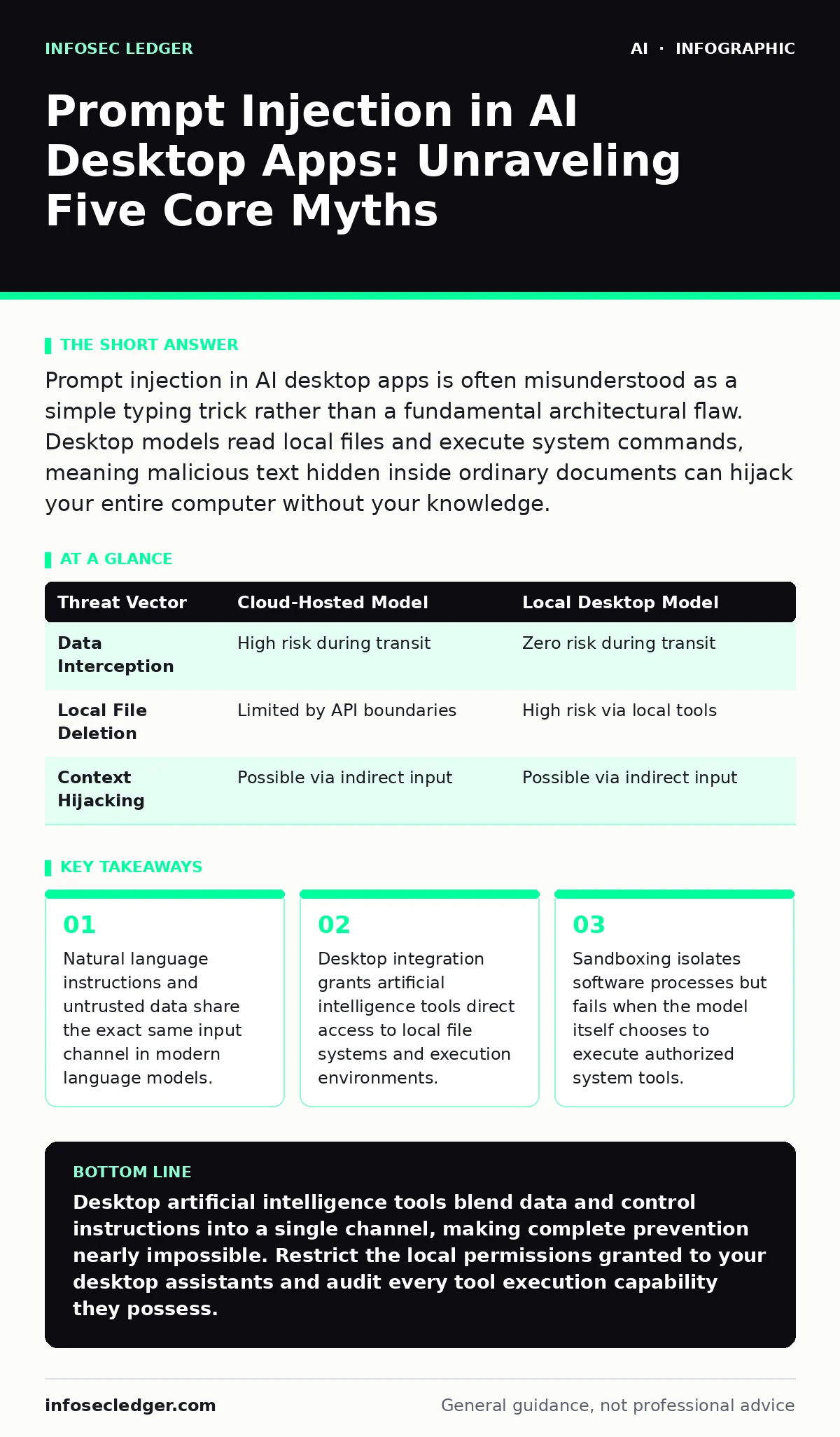
| Threat Vector | Cloud-Hosted Model | Local Desktop Model |
|---|---|---|
| Data Interception | High risk during transit | Zero risk during transit |
| Local File Deletion | Limited by API boundaries | High risk via local tools |
| Context Hijacking | Possible via indirect input | Possible via indirect input |
See also: NIST AI Risk Management Framework: How to secure machine learning
Myth: Adding more alignment training permanently solves the vulnerability
Reality: Alignment training reduces harmful outputs, but it cannot eliminate the fundamental ambiguity of natural language instruction following. As models grow more capable and receive broader tool integrations, the attack surface for semantic manipulation expands accordingly. Developers continuously patch specific bypass techniques, yet novel linguistic variations consistently emerge to trick the underlying architecture.
Model fine-tuning alters probability distributions without fixing the absence of instruction boundaries. 3 iterative training cycles may reduce casual jailbreaking while introducing complex new edge cases. You must treat language models as probabilistic reasoners rather than deterministic software components.
Key takeaways
- Natural language instructions and untrusted data share the exact same input channel in modern language models.
- Desktop integration grants artificial intelligence tools direct access to local file systems and execution environments.
- Sandboxing isolates software processes but fails when the model itself chooses to execute authorized system tools.
Desktop artificial intelligence tools blend data and control instructions into a single channel, making complete prevention nearly impossible. Restrict the local permissions granted to your desktop assistants and audit every tool execution capability they possess.
Frequently asked questions
Can antivirus software detect a prompt injection attack?
Traditional antivirus tools scan for malicious code signatures and binary patterns, failing to recognize natural language text instructions that manipulate artificial intelligence behavior.
Do web-based artificial intelligence applications share these exact same desktop risks?
Web interfaces face indirect prompt injection through untrusted websites and documents, but they typically lack the deep local file system access found in desktop productivity applications.
How can I safely test if my desktop assistant is vulnerable to indirect injection?
You can place harmless text instructions inside a test document instructing a summary tool to output a specific phrase instead of summarizing the actual content.
Should I disable all tool use features in my desktop assistant?
Disabling automated tool execution removes the most dangerous capabilities, though it also eliminates the primary productivity benefits of modern desktop artificial intelligence integration.
How this guide was produced: written by the InfoSec Ledger editorial team with AI assistance, checked against the public references listed below, and reviewed when the facts change. See our editorial policy or report an error.