
What causes generative AI hallucinations and how to stop them
Generative artificial intelligence fabricates falsehoods because probability models prioritize fluent syntax over factual truth.
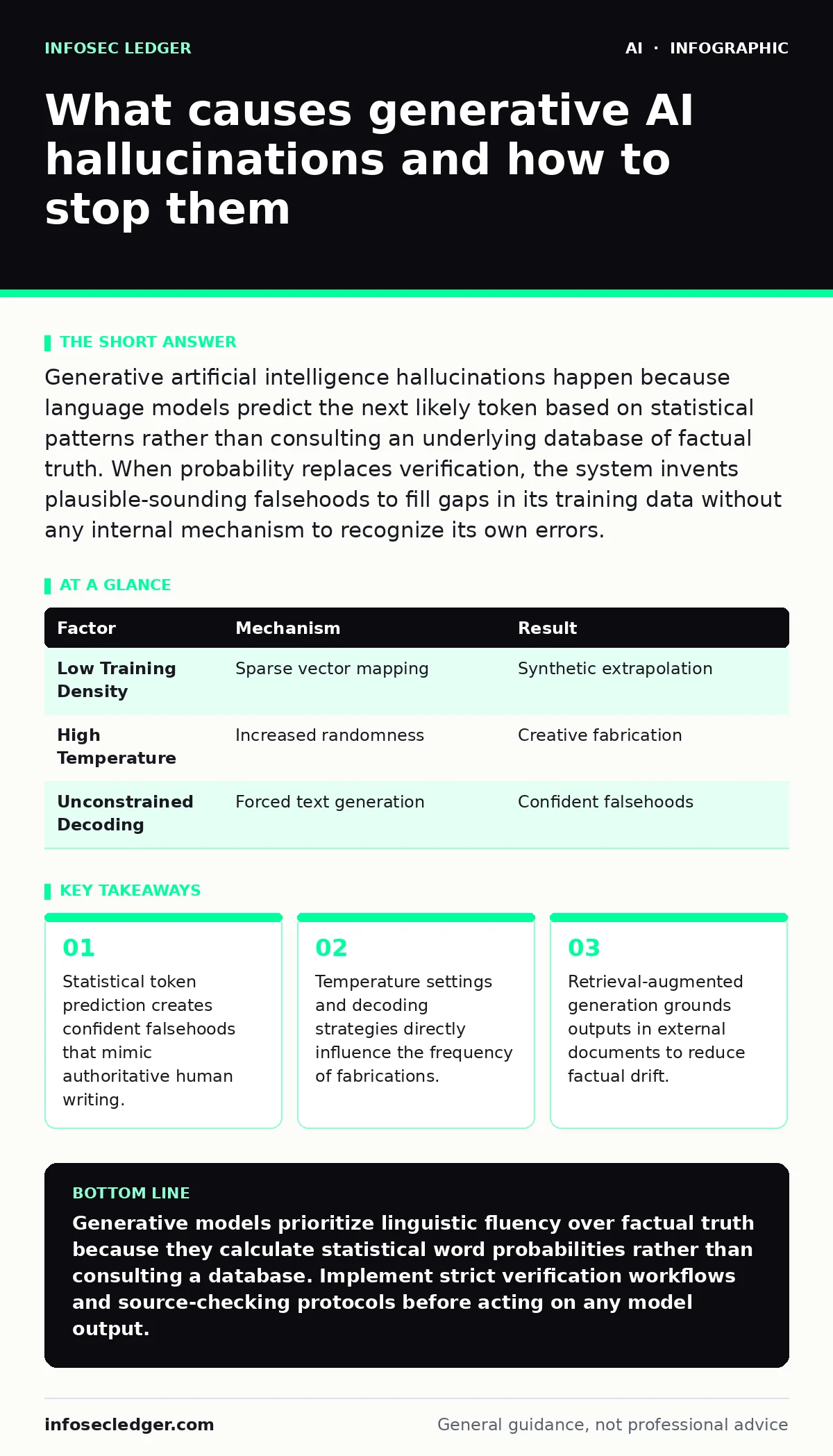
Generative artificial intelligence hallucinations happen because language models predict the next likely token based on statistical patterns rather than consulting an underlying database of factual truth. When probability replaces verification, the system invents plausible-sounding falsehoods to fill gaps in its training data without any internal mechanism to recognize its own errors.
What causes generative AI hallucinations at the architectural level?
What causes generative AI hallucinations is the fundamental reliance on probabilistic token prediction rather than symbolic reasoning. Large language models process text by calculating the mathematical likelihood of the next word sequence based on massive training corpuses. This architecture optimizes for linguistic fluency and contextual plausibility, meaning a grammatically correct lie scores higher than an awkward truth. The underlying neural network lacks a semantic understanding of the physical world, operating entirely on pattern matching across high-dimensional vector spaces.
Why do models invent facts when they lack information?
Models invent facts because forced decoding algorithms compel the system to generate output until reaching a designated stopping token. When a prompt requests information absent from the training weights, the network does not output a null response or a statement of ignorance. Instead, continuous probability curves force the selection of words that statistically fit the context window. This mathematical compulsion treats gaps in knowledge as puzzles to be solved through creative linguistic interpolation rather than acknowledged limits.
How does training data quality trigger fabricated outputs?
Training data quality triggers fabrications when sparse coverage in specialized domains forces models to generalize wildly from unrelated concepts. Ambiguous source material, contradictory statements, and unverified internet text populate the training corpus with faulty associations. When you query the system about a niche topic, the network stitches together disparate fragments that share surface-level linguistic features. This over-generalization mechanism treats rare terminology as interchangeable tokens, creating synthetic historical events or technical procedures.
| Factor | Mechanism | Result |
|---|---|---|
| Low Training Density | Sparse vector mapping | Synthetic extrapolation |
| High Temperature | Increased randomness | Creative fabrication |
| Unconstrained Decoding | Forced text generation | Confident falsehoods |
Can decoding parameters reduce the rate of errors?
Decoding parameters reduce errors by constraining the statistical variance of token selection during text generation. Lowering the temperature parameter forces the model to choose only the highest-probability words, eliminating the creative leaps that often produce fabrications. However, this strict determinism carries a hidden cost of making the output repetitive, rigid, and stylistically monotonous. You trade originality for precision, which degrades performance on tasks requiring nuanced human synthesis or creative brainstorming.
What happens when prompt instructions conflict with internal weights?
Prompt instructions conflict with internal weights when specific user constraints clash with deeply entrenched statistical biases learned during pre-training. The model balances the immediate context window against billions of historical parameters, often resulting in silent overrides where the system ignores your rules. For instance, instructing a model to use only provided source text often fails if the internal weights assign an overwhelmingly high probability to a different narrative. Resolving this tension requires establishing clear AI usage policies at work to govern how staff validate high-stakes outputs.
See also: NIST AI Risk Management Framework: How to secure machine learning
How does context window overflow distort factual recall?
Context window overflow distorts factual recall by dropping earlier instructions and reference documents as input length exceeds processing thresholds. Large language models process information through attention mechanisms that distribute computational focus across token arrays. As text volume increases, the mathematical weight assigned to the beginning of a long prompt decays significantly. This memory degradation causes the system to hallucinate details that contradict the exact reference documents you pasted into the interface minutes prior.
Why do probabilistic systems sound so authoritative when lying?
Probabilistic systems sound authoritative because the linguistic markers of confidence—active voice, precise phrasing, and structured formatting—are statistically correlated with correct answers in training data. The network mimics the tone of academic papers, legal briefs, and technical manuals without possessing the underlying validation checks. You encounter a persuasive persona designed to satisfy the user, making it exceedingly difficult to spot a fabrication without rigorous external verification. This behavioral trait mirrors deepfake fraud, where smooth presentation masks a total lack of underlying authenticity.
Key takeaways
- Statistical token prediction creates confident falsehoods that mimic authoritative human writing.
- Temperature settings and decoding strategies directly influence the frequency of fabrications.
- Retrieval-augmented generation grounds outputs in external documents to reduce factual drift.
Generative models prioritize linguistic fluency over factual truth because they calculate statistical word probabilities rather than consulting a database. Implement strict verification workflows and source-checking protocols before acting on any model output.
Frequently asked questions
Can fine-tuning a model completely eliminate hallucinations?
Fine-tuning shapes behavioral style and domain-specific vocabulary, but it cannot remove the fundamental probabilistic nature that generates fabrications.
Why do hallucinations increase during long multi-turn conversations?
Cumulative error propagation causes models to build subsequent responses upon their own previously fabricated statements.
Does increasing model size reduce the frequency of fabrications?
Larger parameter counts improve general reasoning and factual retention, but they can also make fabrications more articulate and harder to detect.
How do developers test for hallucination rates before deployment?
Evaluation frameworks feed benchmark datasets with known ground truths into the model to measure factual divergence rates.
How this guide was produced: written by the InfoSec Ledger editorial team with AI assistance, checked against the public references listed below, and reviewed when the facts change. See our editorial policy or report an error.