
NIST AI Risk Management Framework: How to secure machine learning
Standardizing artificial intelligence governance prevents silent operational failures before deployment.
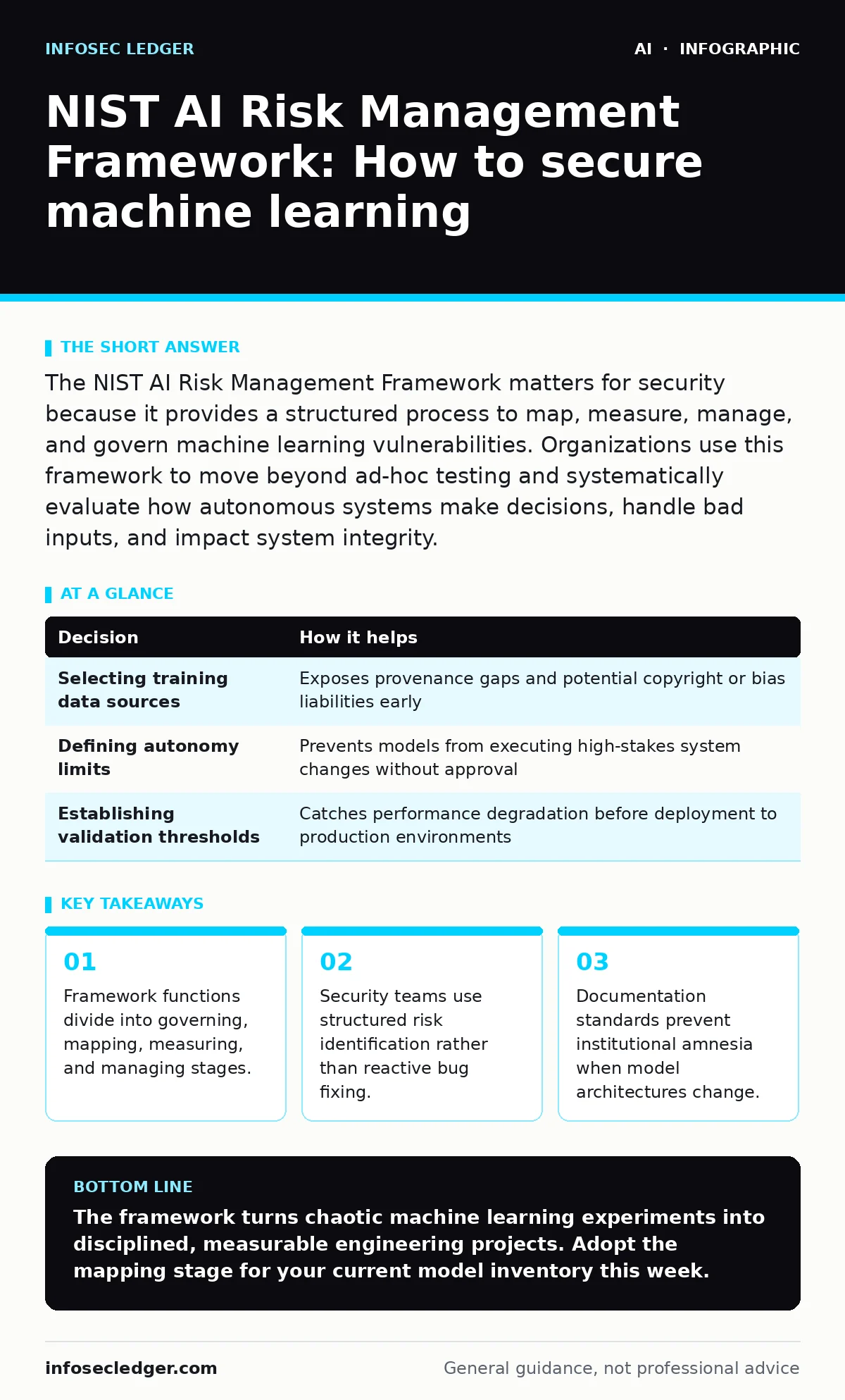
The NIST AI Risk Management Framework matters for security because it provides a structured process to map, measure, manage, and govern machine learning vulnerabilities. Organizations use this framework to move beyond ad-hoc testing and systematically evaluate how autonomous systems make decisions, handle bad inputs, and impact system integrity.
Why Security Teams Adopt Standardized Governance
Artificial intelligence systems introduce failure modes that traditional software testing misses entirely. Traditional code executes deterministic logic, whereas machine learning models operate on probabilistic inferences derived from training data. When a standard application breaks, it throws an error code and stops processing.
When an intelligent system fails, it often continues running while producing plausible-sounding fabrications, similar to issues you might encounter when addressing AI hallucinations in production environments. Standardized frameworks establish common vocabularies so engineering, legal, and security departments can evaluate these risks together before models interact with sensitive infrastructure.
The Cost of Operating Without a Risk Framework
Organizations often deploy machine learning models based solely on accuracy metrics during testing phases. Testing accuracy ignores systemic drift, adversarial manipulation, and unexpected behavioral changes when inputs shift outside training boundaries. Imagine a customer support model that functions correctly during pilot tests but gradually learns to accept malicious prompt injections over time.
Without structured risk management, teams lack the diagnostic trail required to trace why an automated system approved an unauthorized transaction or leaked proprietary logic. This reactive posture leaves businesses scrambling to patch symptoms while the underlying model architecture remains fundamentally flawed.
Mapping System Boundaries and Dependencies
Mapping requires you to document every component flowing into and out of an intelligent system. 3 distinct elements need strict cataloging: training datasets, third-party libraries, and dependent application programming interfaces. Mapping exposes hidden data pipelines where biased or poisoned inputs could compromise model integrity. Security professionals use this stage to define operational boundaries, establishing what decisions the model is permitted to make autonomously versus what requires human confirmation. Clear boundaries prevent cascading failures when an autonomous component encounters edge cases it was never designed to handle.
| Decision | How it helps |
|---|---|
| Selecting training data sources | Exposes provenance gaps and potential copyright or bias liabilities early |
| Defining autonomy limits | Prevents models from executing high-stakes system changes without approval |
| Establishing validation thresholds | Catches performance degradation before deployment to production environments |
Measuring Vulnerabilities and System Robustness
Measuring involves quantitative and qualitative evaluation of model resilience against targeted attacks. Unlike static code analysis, measuring machine learning requires testing how inputs mutate model outputs under adversarial pressure. 2 primary testing vectors deserve attention: evasion attacks that trick the model into misclassifying inputs, and extraction attacks that steal proprietary training parameters. Teams must measure false positive rates not just as an average, but across demographic and operational subgroups to ensure equitable and secure performance under varied conditions.
Managing Identified Risks Through Technical Controls
Managing transforms assessment findings into concrete engineering controls and architectural constraints. Engineers apply adversarial training by intentionally feeding malicious inputs back into the development pipeline to harden the model against future exploitation. Managing also involves implementing strict access controls for AI agents to ensure autonomous routines cannot bypass network boundaries or execute unauthorized system commands. Every mitigation strategy requires continuous monitoring, because a secure model can become vulnerable overnight as underlying data distributions shift.
See also: Intelligence Cycle Steps: How to Turn Data Into Actionable Security Insights
Governing Accountability Across Departments
Governance establishes organizational oversight, ensuring that technical teams do not operate in an operational vacuum. Accountability must span multiple departments because model security intersects with legal compliance, ethical standards, and brand reputation. Documenting every decision made during development creates an audit trail that satisfies regulatory scrutiny and internal compliance requirements. Effective governance also requires clear policies regarding employee interactions with machine learning tools, often formalized through comprehensive AI usage policies at work to prevent accidental leakage of trade secrets into public model training sets.
Operationalizing Continuous Improvement Cycles
Continuous improvement treats model deployment as the beginning of the security lifecycle rather than the end. Data drifts, user behavior evolves, and attackers invent novel ways to exploit probabilistic logic. Organizations must schedule routine re-evaluations of model assumptions, retraining parameters, and validation thresholds. Maintaining this vigilance ensures that security posture scales alongside the increasing complexity of deployed artificial intelligence systems.
Key takeaways
- Framework functions divide into governing, mapping, measuring, and managing stages.
- Security teams use structured risk identification rather than reactive bug fixing.
- Documentation standards prevent institutional amnesia when model architectures change.
The framework turns chaotic machine learning experiments into disciplined, measurable engineering projects. Adopt the mapping stage for your current model inventory this week.
Frequently asked questions
Does this framework apply to small businesses without dedicated data science teams?
Yes, because small businesses frequently integrate third-party machine learning APIs rather than training models from scratch. The framework helps smaller teams evaluate the security practices and hidden risks of external vendors before entrusting them with company data.
How does this guidance differ from traditional cybersecurity frameworks?
Traditional frameworks focus primarily on network perimeters, system hardening, and static access controls. This standard addresses probabilistic outputs, data provenance, and behavioral drift that traditional vulnerability scanners cannot detect.
Can this framework prevent all forms of algorithmic bias?
No, standard frameworks provide structured processes to identify and mitigate bias, but they cannot guarantee complete elimination. They help teams measure disparate impact so they can make informed decisions about whether a model is safe to deploy.
What is the first step an engineering team should take when adopting this methodology?
The initial step is convening a cross-functional group to map all existing and planned machine learning models, their data sources, and their operational dependencies.
How this guide was produced: written by the InfoSec Ledger editorial team with AI assistance, checked against the public references listed below, and reviewed when the facts change. See our editorial policy or report an error.