
ARP Spoofing Explained: How Local Network Attacks Steal Data
ARP spoofing bypasses firewalls by tricking devices into trusting a fake neighbor, allowing attackers to intercept traffic without leaving the local network.
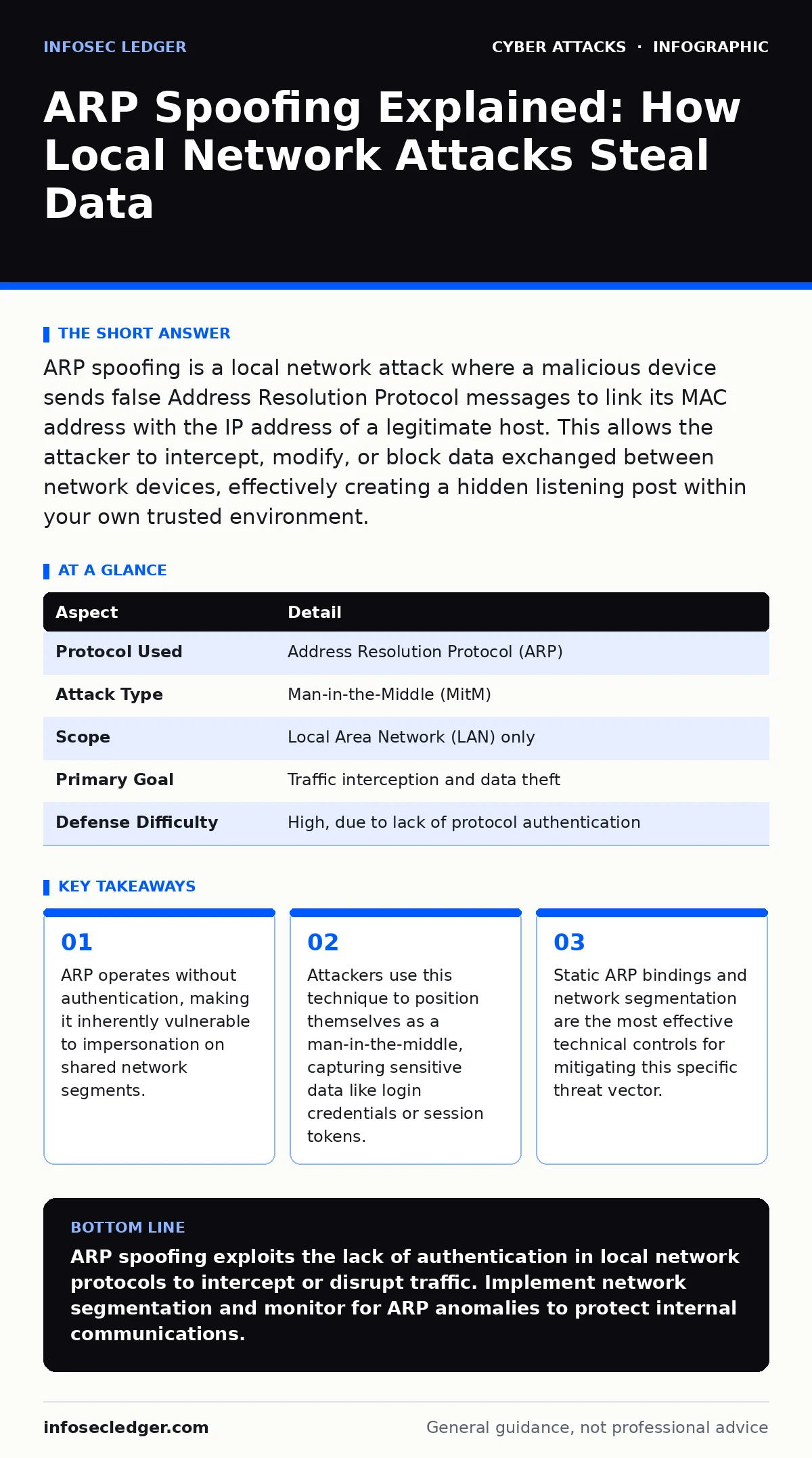
ARP spoofing is a local network attack where a malicious device sends false Address Resolution Protocol messages to link its MAC address with the IP address of a legitimate host. This allows the attacker to intercept, modify, or block data exchanged between network devices, effectively creating a hidden listening post within your own trusted environment.
The Mailroom Analogy for Network Traffic
Imagine a busy office building where every department has a unique room number. To deliver a package, the mailroom needs to know which physical room corresponds to that number. Address Resolution Protocol, or ARP, is the digital equivalent of asking, "Who lives at room 402?" The system relies on trust. When a device answers, "I am room 402," the mailroom accepts that claim without checking identification. An attacker can simply shout, "I am room 402," causing all mail intended for that room to be delivered to them instead.
This lack of verification is the core vulnerability. ARP was designed for small, trusted local networks where devices were assumed to be honest. It does not include mechanisms to verify that a device is actually who it claims to be. Consequently, any device on the same local network segment can pretend to be any other device. This creates a blind spot in network security that perimeter defenses cannot easily address.
How ARP Spoofing Works Step by Step
The attack begins when a malicious device connects to the same local network as the target. The attacker then broadcasts fake ARP messages. These messages claim that the attacker’s hardware address, known as a MAC address, is associated with the IP address of a legitimate device, such as the default gateway or a specific server.
Other devices on the network update their ARP cache, which is a temporary table that maps IP addresses to MAC addresses. They now believe the attacker is the legitimate device. When the target tries to send data to the legitimate device, it sends the packets to the attacker’s MAC address instead. The attacker can then read the data, modify it, or forward it to the real device to maintain the flow of traffic and avoid detection.
| Aspect | Detail |
|---|---|
| Protocol Used | Address Resolution Protocol (ARP) |
| Attack Type | Man-in-the-Middle (MitM) |
| Scope | Local Area Network (LAN) only |
| Primary Goal | Traffic interception and data theft |
| Defense Difficulty | High, due to lack of protocol authentication |
Who Gets Hit and Why It Matters
This attack affects anyone sharing a local network segment. In a home environment, this means all devices connected to the same Wi-Fi router are potentially vulnerable to each other. In a business setting, devices on the same switch or VLAN share this risk. The impact is significant because it bypasses the assumption that internal traffic is safe.
Many organizations invest heavily in encrypting data as it travels across the internet. However, data often travels in plain text within the local network. If an attacker intercepts this traffic, they can read unencrypted HTTP requests, capture login credentials, or steal session cookies. This makes session cookie theft a common byproduct of successful ARP spoofing. Once an attacker has a valid session cookie, they can impersonate the user without needing their password, bypassing many standard authentication checks.
Common Forms of ARP-Based Attacks
The most common form is the classic man-in-the-middle attack. The attacker sits between two communicating parties, silently copying all data. This allows for the harvesting of credentials, intellectual property, or personal information. The traffic appears normal to both parties, making detection difficult without specialized monitoring tools.
Another form is the Denial of Service attack. The attacker sends fake ARP replies that map a legitimate device’s IP address to a non-existent MAC address. The target device sends packets to this invalid address, and the data disappears into the ether. The victim experiences a loss of connectivity, often blaming the network infrastructure rather than suspecting a malicious actor. This disrupts operations and can mask other ongoing attacks by creating confusion.
What People Usually Get Wrong
A common misconception is that using a strong firewall prevents ARP spoofing. Firewalls filter traffic based on IP addresses and ports at the network boundary. ARP spoofing occurs at the data link layer, below the level where most firewalls operate. The malicious traffic never crosses the firewall; it stays within the local network. Therefore, perimeter security provides zero protection against this specific threat.
Another error is assuming that encryption solves the problem entirely. While encrypting all traffic, such as using HTTPS, prevents the attacker from reading the content, it does not stop the interception itself. The attacker can still disrupt connections, perform man-in-the-middle attacks on unencrypted services, or inject malicious data into the stream. Relying solely on encryption leaves the network vulnerable to disruption and protocol-level manipulation.
See also: Botnet Attack Response: Step-by-Step Recovery and Containment · Third-Party Cookies: Hidden Risks and Protection for Small Businesses
Reducing the Risk of ARP Spoofing
The most effective technical control is to use static ARP bindings. This involves manually configuring devices to associate specific IP addresses with specific MAC addresses. This prevents devices from accepting dynamic ARP updates from unknown sources. However, this is difficult to maintain in large networks with many devices and frequent changes.
Network segmentation is another powerful strategy. By dividing the network into smaller subnets or VLANs, you limit the scope of the attack. An attacker on one segment cannot spoof ARP requests to devices on another segment. This reduces the potential damage and limits the number of devices an attacker can target. Implementing attack surface reduction techniques by minimizing the number of devices on shared segments further lowers the risk.
Detecting and Responding to ARP Anomalies
Detection requires monitoring for ARP anomalies. Security information and event management systems can alert on rapid changes in ARP tables or multiple devices claiming the same IP address. These indicators suggest an active spoofing attempt. Regular audits of network traffic patterns can also reveal unusual flows that do not match expected behavior.
When an attack is detected, immediate isolation of the affected segment is necessary. Disconnecting the malicious device stops the spoofing. Following this, review logs to determine what data was intercepted. If sensitive information was compromised, initiate your incident response plans to mitigate the fallout. This may include resetting credentials, revoking sessions, and notifying affected users.
The Hidden Cost of Internal Trust
The deeper insight here is that ARP spoofing exploits the inherent trust within local networks. We often focus on external threats, neglecting the fact that the local network is a shared resource with minimal verification. This creates a hidden cost: the need for internal network security measures that are often overlooked.
Ignoring this risk leaves your organization vulnerable to data theft and disruption from within. By understanding how ARP works and implementing controls like segmentation and static bindings, you close a critical gap in your security posture. This approach ensures that trust is not assumed but verified, even at the most basic network levels.
Key takeaways
- ARP operates without authentication, making it inherently vulnerable to impersonation on shared network segments.
- Attackers use this technique to position themselves as a man-in-the-middle, capturing sensitive data like login credentials or session tokens.
- Static ARP bindings and network segmentation are the most effective technical controls for mitigating this specific threat vector.
- Traditional perimeter defenses like firewalls often fail to detect ARP spoofing because the malicious traffic never leaves the local subnet.
ARP spoofing exploits the lack of authentication in local network protocols to intercept or disrupt traffic. Implement network segmentation and monitor for ARP anomalies to protect internal communications.
Frequently asked questions
Can ARP spoofing happen over Wi-Fi?
Yes, Wi-Fi networks create a shared broadcast domain where all devices can see each other’s traffic, making them highly susceptible to ARP spoofing unless properly segmented.
Does using HTTPS prevent ARP spoofing?
HTTPS prevents the attacker from reading the intercepted data, but it does not stop the spoofing itself or the potential for connection disruption or injection attacks.
How do I know if I am being ARP spoofed?
Look for sudden connectivity issues, unexpected changes in your ARP table, or alerts from network monitoring tools indicating multiple MAC addresses for a single IP.
Is static ARP binding enough protection?
Static ARP binding is effective but difficult to maintain at scale. It should be combined with network segmentation and monitoring for a layered defense strategy.
How this guide was produced: written by the InfoSec Ledger editorial team with AI assistance, checked against the public references listed below, and reviewed when the facts change. See our editorial policy or report an error.