
AI Model Serving Vulnerabilities: Debunking 6 Common Security Myths
Serving frameworks expose attack surfaces that traditional web application firewalls cannot see because they process data structures, not just network packets.
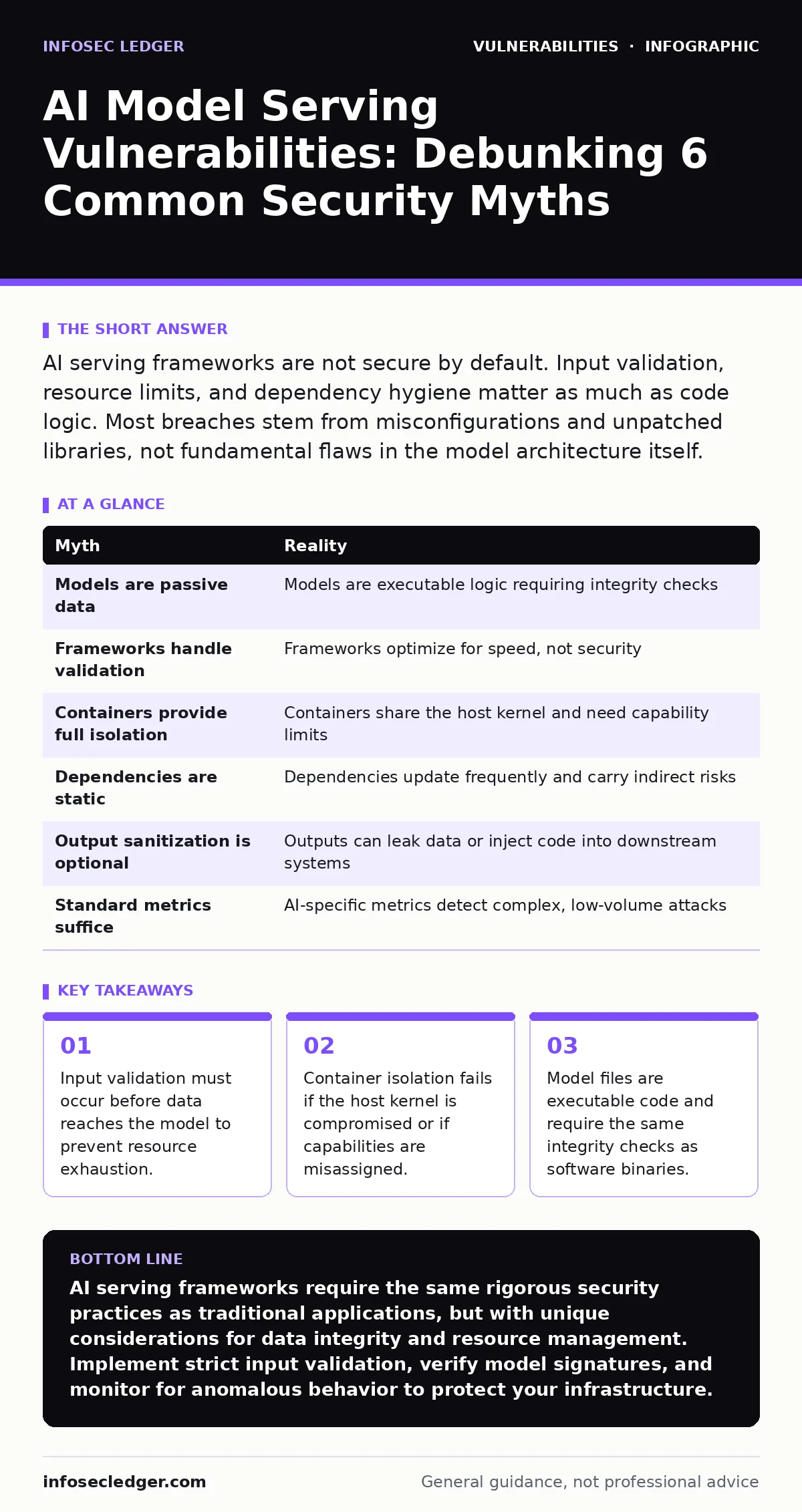
AI serving frameworks are not secure by default. Input validation, resource limits, and dependency hygiene matter as much as code logic. Most breaches stem from misconfigurations and unpatched libraries, not fundamental flaws in the model architecture itself.
Myth: AI Models Are Data, Not Code
Reality: Machine learning models function as executable logic. When you load a model file into memory, the framework interprets weights, biases, and layer definitions as instructions for computation. This means a corrupted or malicious model file can alter behavior, exfiltrate data, or crash the serving process.
Treating models as passive data ignores the risk of supply chain attacks. An attacker who compromises a model repository can inject malicious layers that execute arbitrary code during inference. You must verify the cryptographic signature of every model file before loading it. This verification step ensures the model has not been tampered with since it was exported.
Myth: Input Validation Is Handled by the Framework
Reality: Serving frameworks optimize for speed, not security. They assume inputs match the expected schema and skip deep inspection to reduce latency. If you send a malformed tensor or an excessively large image, the framework may allocate memory until the system crashes. This is a denial-of-service vector that bypasses standard web application firewalls.
You must implement strict input validation at the edge. Check dimensions, data types, and value ranges before the request reaches the model. A simple check that rejects images larger than a specific pixel count prevents resource exhaustion. This adds milliseconds to latency but stops attackers from consuming all available CPU or memory resources.
Imagine an attacker sending a request with infinite precision floating-point numbers. The framework might spend hours processing these values, blocking other legitimate users. Your validation layer must reject such edge cases immediately.
Myth: Containerization Provides Complete Isolation
Reality: Containers share the host kernel. If an attacker finds a privilege escalation vulnerability in the container runtime or the host kernel, they escape the container entirely. Most serving frameworks run with elevated privileges to access GPUs or specialized hardware, increasing the blast radius of a breach.
You must limit container capabilities. Remove unnecessary Linux capabilities and run the service as a non-root user. Use seccomp profiles to restrict system calls. This containment strategy ensures that even if the model serving process is compromised, the attacker cannot modify the host system or access other containers.
Myth: Dependencies Are Static and Safe
Reality: AI frameworks rely on dozens of complex libraries. These dependencies update frequently and often contain vulnerabilities. A serving framework might be secure, but its underlying linear algebra library could have a buffer overflow. This indirect risk is often overlooked because teams focus only on the primary framework.
You must implement strict patch management for all dependencies. Use tools to scan for known vulnerabilities in your library tree. Update libraries promptly, but test for compatibility before deploying. A broken dependency can cause silent data corruption, which is worse than a crash.
Review the dependency graph of your serving framework. Identify which libraries interact directly with network inputs or file systems. These components require the highest level of scrutiny and frequent updates.
Myth: Output Sanitization Is Unnecessary
Reality: Model outputs can contain sensitive information or malicious payloads. If your model generates text, it might leak training data or produce SQL injection strings that your downstream application interprets as code. This is a form of server-side template injection where the model acts as the vector.
You must sanitize all model outputs before they reach other systems. Validate that generated text matches expected formats and does not contain executable commands. If your model generates code, run it in a sandboxed environment. This defense-in-depth approach prevents the model from becoming a bridge to other vulnerabilities.
Consider a chatbot that generates JSON responses. If the JSON structure is malformed, your parser might crash. Validate the JSON schema strictly. This prevents downstream errors and potential injection attacks.
See also: Securing AI Agents With Information-Flow Control: The Silent Boundary · Access Controls for AI Agents: Secure Autonomous Systems
Myth: Monitoring Standard Metrics Is Enough
Reality: Standard metrics like CPU usage and request count miss AI-specific attacks. An attacker might send low-volume, high-complexity requests that consume disproportionate resources. These requests look normal in standard logs but degrade performance significantly. This is a slow-and-low denial-of-service attack.
You must monitor model-specific metrics. Track inference latency, memory allocation per request, and input distribution shifts. Sudden changes in input patterns often indicate adversarial attacks. Set alerts for anomalies in these metrics. This allows you to detect and block attacks before they impact service availability.
Integrate these metrics into your threat modeling for applications. Understand how an attacker might abuse model behavior. This proactive approach helps you design better defenses and detection rules.
| Myth | Reality |
|---|---|
| Models are passive data | Models are executable logic requiring integrity checks |
| Frameworks handle validation | Frameworks optimize for speed, not security |
| Containers provide full isolation | Containers share the host kernel and need capability limits |
| Dependencies are static | Dependencies update frequently and carry indirect risks |
| Output sanitization is optional | Outputs can leak data or inject code into downstream systems |
| Standard metrics suffice | AI-specific metrics detect complex, low-volume attacks |
Key takeaways
- Input validation must occur before data reaches the model to prevent resource exhaustion.
- Container isolation fails if the host kernel is compromised or if capabilities are misassigned.
- Model files are executable code and require the same integrity checks as software binaries.
AI serving frameworks require the same rigorous security practices as traditional applications, but with unique considerations for data integrity and resource management. Implement strict input validation, verify model signatures, and monitor for anomalous behavior to protect your infrastructure.
Frequently asked questions
How do I prevent model poisoning attacks?
Verify the cryptographic signature of model files and restrict write access to model repositories. Ensure only trusted users can update models.
Should I expose my AI model directly to the internet?
No. Place your serving framework behind a reverse proxy that handles authentication, rate limiting, and input validation before requests reach the model.
What is the biggest risk in AI deployment?
Misconfiguration is the biggest risk. Most breaches occur because defaults are insecure, dependencies are unpatched, or input validation is missing.
How often should I update AI dependencies?
Update dependencies regularly, but test thoroughly in a staging environment. Balance the need for security patches with the risk of breaking compatibility.
How this guide was produced: written by the InfoSec Ledger editorial team with AI assistance, checked against the public references listed below, and reviewed when the facts change. See our editorial policy or report an error.