
SEO Poisoning Myths: Why Your Site Is Not the Only Target
Search engine optimization poisoning rarely targets your domain directly; it hijacks the trust users place in search results to redirect them to malicious infrastructure you do not control.
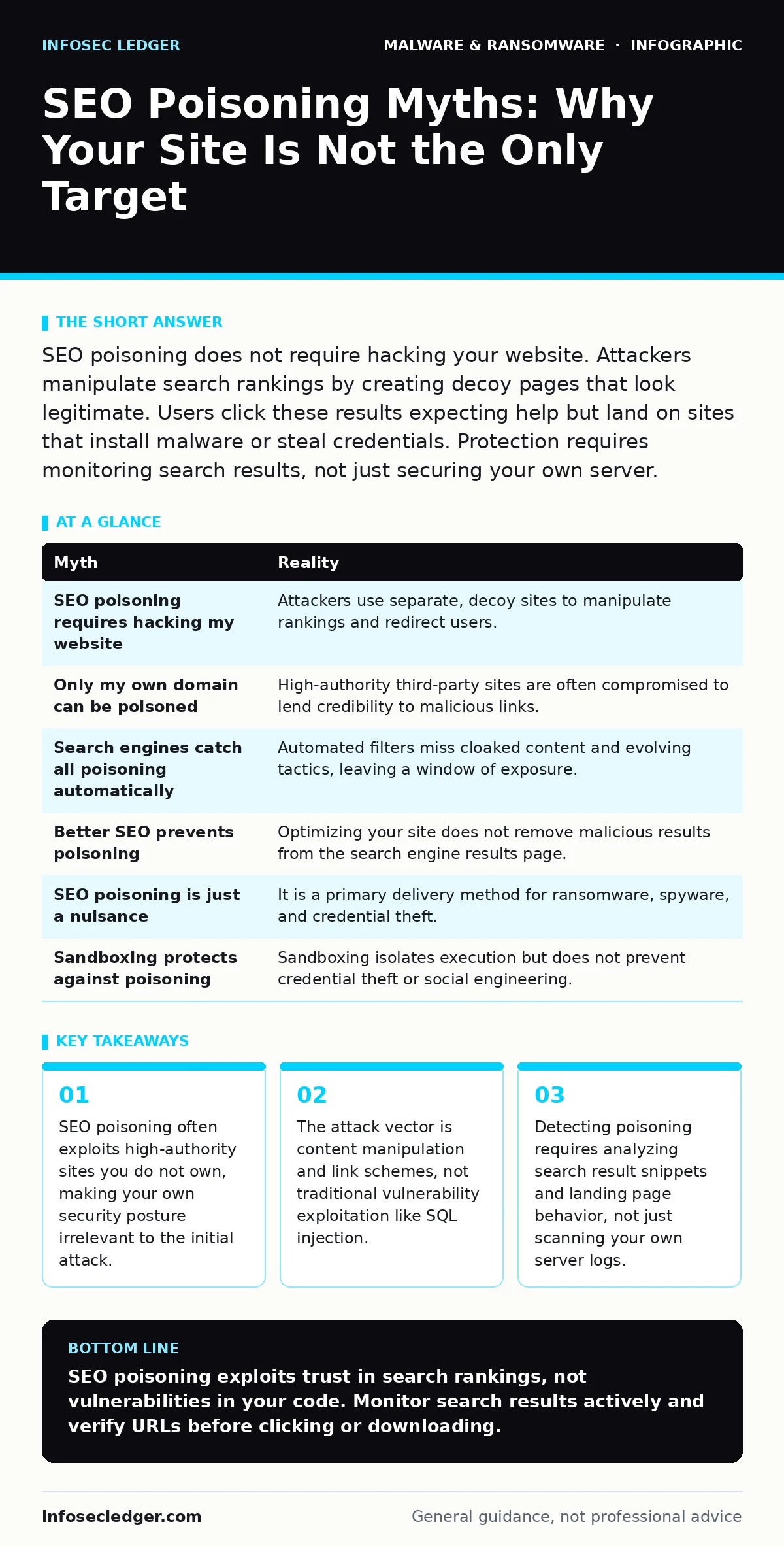
SEO poisoning does not require hacking your website. Attackers manipulate search rankings by creating decoy pages that look legitimate. Users click these results expecting help but land on sites that install malware or steal credentials. Protection requires monitoring search results, not just securing your own server.
Myth: SEO poisoning requires hacking my website
Reality: You do not need a compromised server for SEO poisoning to succeed against your brand or users. Attackers often create entirely separate, low-quality websites designed to rank for specific queries. These sites mimic the appearance of trusted resources or popular software downloads. They use black hat techniques to trick search algorithms into placing them at the top of results.
Imagine a user searching for a specific software patch. The attacker has created a page that ranks higher than the official vendor site. The page looks identical to the real one but links to a payload. Your website remains untouched, secure, and fully compliant with standards. The damage occurs because the user trusts the search engine’s ranking, not because your infrastructure failed.
This misconception leads organizations to focus exclusively on perimeter defense. They invest in firewalls and intrusion detection systems while ignoring the external threat surface. The real vulnerability is the user’s reliance on search result placement as a proxy for safety. This dynamic mirrors the behavior of browser hijackers, which also alter user experience without necessarily compromising the underlying operating system.
Myth: Only my own domain can be poisoned
Reality: Attackers frequently target third-party sites with high domain authority to boost the credibility of their malicious links. This is known as a reflective SEO poisoning attack. The attacker compromises a legitimate, high-trust site to host or link to their malicious payload. The search engine sees the link coming from a trusted source and ranks the malicious result higher.
Your domain might never appear in the attack chain. The attacker uses the reputation of another site to launder their malicious intent. When users click the result, they may be redirected through several hops before reaching the final payload. This makes attribution difficult and traditional domain blocking ineffective.
This technique exploits the trust transfer mechanism inherent in search algorithms. A link from a reputable news outlet or educational institution carries more weight than one from a new blog. By poisoning these high-authority sites, attackers gain an unfair ranking advantage. This is distinct from rootkits, which hide at the system level, as this attack hides in the presentation layer of search results.
Myth: Google and other engines catch all poisoning automatically
Reality: Search engines use automated systems to detect and demote malicious content, but these systems are not perfect. Attackers constantly evolve their tactics to bypass algorithmic filters. They use cloaking to show benign content to search engine crawlers while serving malicious content to human visitors.
Crawlers are automated programs that browse the web to index content. If a crawler sees a clean page, it indexes it. When a human user visits, a script detects the user-agent string and serves the malicious version. This discrepancy is hard for automated systems to detect in real time. The latency between detection and ranking adjustment leaves a window of exposure.
Furthermore, search engines prioritize relevance and freshness. A well-crafted poisoning attack can mimic high-quality content so closely that it passes initial quality filters. It may take days or weeks for the malicious nature of the site to become apparent through user reports or behavioral analysis. During this time, the damage is already done.
Myth: I can prevent poisoning by optimizing my SEO better
Reality: Improving your own search engine optimization does not remove malicious results from the search engine results page. Good SEO increases the visibility of your legitimate content, but it does not delete competitor or attacker pages. The search results page has limited space, and attackers compete for the same keywords you do.
Attackers use aggressive link-building and keyword stuffing to outrank legitimate sites. Even if your site is technically superior and provides better user experience, the attacker’s manipulative tactics may win the ranking war temporarily. This is a race against time and algorithmic updates, not a quality contest.
Focusing solely on your own optimization ignores the external threat. You must monitor the search results for your brand and key products. If a malicious site appears, you must report it to the search engine. Relying on your own SEO strength to push attackers off the first page is a flawed strategy. It is similar to hoping that file hashes in malware detection will catch every new variant without updating the signature database.
Myth: SEO poisoning is just a nuisance, not a security risk
Reality: SEO poisoning is a primary delivery mechanism for severe malware families. The goal is not just to generate ad revenue or traffic; it is to install persistent threats on user devices. These threats can include ransomware, spyware, and information stealers.
The search result provides the social engineering hook. Users are looking for a solution to a problem, such as a software crack or a tax form. The poisoned result offers exactly what they want. The download triggers the infection. Because the user initiated the action based on a trusted search result, they are less likely to suspect the file.
This makes SEO poisoning more dangerous than scareware, which relies on fear to trick users. Scareware requires the user to be alarmed. SEO poisoning requires only that the user be satisfied. The attack is silent and efficient. It turns the convenience of search into a vector for compromise.
See also: How Scareware Works: The Psychological Trap Step by Step · Browser Hijackers: How They Bypass Defenses and Steal Data
Myth: If I use a sandbox, I am safe from poisoning results
Reality: Sandboxing isolates applications to prevent them from affecting the main system, but it does not stop the initial deception. A sandbox is a controlled environment where untrusted software can run without harming the host. It is effective against many types of malware, but not against the psychological trickery of SEO poisoning.
If a user copies data from a sandboxed browser to the host system, the damage can still occur. More importantly, some malware is designed to detect sandbox environments and remain dormant. It waits until it is moved to a live system before activating. The initial click and download happen within the sandbox, giving a false sense of security.
Additionally, SEO poisoning often leads to credential theft via phishing pages. Sandboxing does not prevent a user from typing their password into a fake login page that looks identical to the real one. The data is sent to the attacker immediately. The isolation of the browser does not protect the account credentials entered within it.
| Myth | Reality |
|---|---|
| SEO poisoning requires hacking my website | Attackers use separate, decoy sites to manipulate rankings and redirect users. |
| Only my own domain can be poisoned | High-authority third-party sites are often compromised to lend credibility to malicious links. |
| Search engines catch all poisoning automatically | Automated filters miss cloaked content and evolving tactics, leaving a window of exposure. |
| Better SEO prevents poisoning | Optimizing your site does not remove malicious results from the search engine results page. |
| SEO poisoning is just a nuisance | It is a primary delivery method for ransomware, spyware, and credential theft. |
| Sandboxing protects against poisoning | Sandboxing isolates execution but does not prevent credential theft or social engineering. |
Key takeaways
- SEO poisoning often exploits high-authority sites you do not own, making your own security posture irrelevant to the initial attack.
- The attack vector is content manipulation and link schemes, not traditional vulnerability exploitation like SQL injection.
- Detecting poisoning requires analyzing search result snippets and landing page behavior, not just scanning your own server logs.
SEO poisoning exploits trust in search rankings, not vulnerabilities in your code. Monitor search results actively and verify URLs before clicking or downloading.
Frequently asked questions
How do I know if my site has been poisoned?
Check your search results for unexpected or low-quality sites ranking for your brand. Look for sites that mimic your design but have different domains. If you see them, report them to the search engine.
Can SEO poisoning affect mobile users?
Yes, mobile users are often more vulnerable because they have smaller screens and may not notice subtle URL differences. Malicious mobile apps are sometimes distributed through these poisoned search results.
Does using HTTPS prevent SEO poisoning?
No, HTTPS encrypts data between the user and the site, but it does not verify the legitimacy of the site’s content or its ranking. Attackers often use HTTPS on malicious sites to appear more trustworthy.
Should I block all search engine crawlers?
No, blocking crawlers removes your site from search results, which hurts legitimate traffic. Instead, use robots.txt to disallow specific directories if necessary, but focus on monitoring and reporting malicious sites.
How this guide was produced: written by the InfoSec Ledger editorial team with AI assistance, checked against the public references listed below, and reviewed when the facts change. See our editorial policy or report an error.