
Configuration Drift: How to Detect and Fix Cloud Security Gaps
Unintended changes to cloud settings accumulate silently, creating security gaps that manual audits miss and automated tools often ignore until an incident occurs.
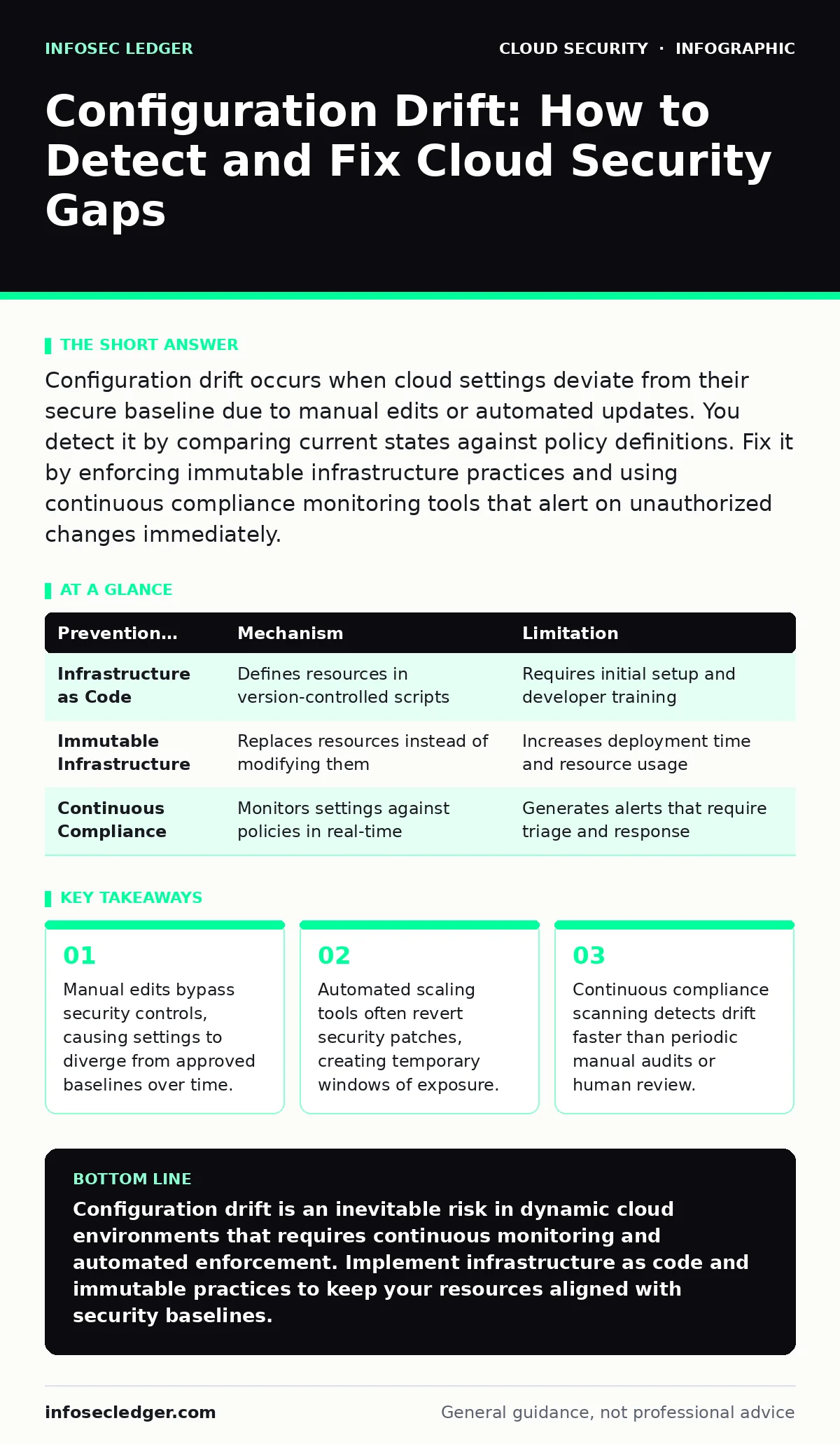
Configuration drift occurs when cloud settings deviate from their secure baseline due to manual edits or automated updates. You detect it by comparing current states against policy definitions. Fix it by enforcing immutable infrastructure practices and using continuous compliance monitoring tools that alert on unauthorized changes immediately.
What is configuration drift in cloud environments?
Configuration drift is the gradual divergence of cloud resource settings from their intended, secure baseline state. This divergence happens when administrators make manual changes, when automated tools update configurations, or when services interact in unexpected ways. The cloud environment does not stay static. Every change, whether intentional or accidental, moves the system away from its original secure design. You must treat the cloud as a dynamic entity that requires constant verification, not a static server that you configure once and forget.
Why does configuration drift happen so frequently?
Configuration drift happens because cloud environments are complex and multiple teams often manage different components without full visibility into each other’s actions. One team might open a port for testing and forget to close it. Another team might deploy a new application that modifies security groups. Automated scaling events can also reset configurations to default, insecure states. The speed of cloud deployment outpaces the speed of manual documentation. When changes are not tracked in code, the actual state becomes unknown, and drift becomes inevitable.
How does configuration drift increase security risk?
Configuration drift increases security risk by creating unauthorized access points and disabling security controls that were previously active. A single misconfigured storage bucket can expose sensitive data to the public internet. A changed firewall rule might allow traffic from untrusted networks. These changes are often subtle and do not trigger immediate alarms. Attackers scan for these common misconfigurations constantly. The longer drift goes undetected, the larger the attack surface grows. You expose your organization to data breaches, compliance violations, and service disruptions.
Can you detect configuration drift without specialized tools?
You can detect configuration drift without specialized tools by manually comparing current configurations against documented baselines, but this method is slow and error-prone. Manual audits require logging into each service, checking settings, and recording findings. This process is impossible to scale across hundreds of resources. It also provides only a point-in-time view, missing changes that occur between audits. Specialized tools automate this comparison continuously. They alert you the moment a setting changes. Relying on manual checks alone leaves significant gaps in your security posture.
What is the difference between drift and intended changes?
The difference between drift and intended changes lies in authorization and documentation. Intended changes are planned, approved, and recorded in version control systems. They follow a defined process that includes security review. Drift consists of unauthorized, undocumented, or forgotten changes. These changes often occur during troubleshooting or emergency fixes. Without a strict change management process, it is difficult to distinguish between necessary updates and dangerous drift. You must enforce a policy where all configuration changes are codified and tracked to maintain clarity.
See also: Conditional Access Policies Best Practices for Secure Identity · Cloud Cryptojacking: Warning Signs and Immediate Response Steps
How do you prevent configuration drift effectively?
You prevent configuration drift effectively by adopting infrastructure as code and immutable infrastructure principles. Infrastructure as code means defining all cloud resources in version-controlled scripts. Any change must go through a code review and automated testing pipeline. Immutable infrastructure means replacing resources instead of modifying them in place. When a configuration change is needed, you deploy a new resource with the updated settings and decommission the old one. This eliminates the possibility of accidental manual edits. It ensures every resource matches the approved baseline.
| Prevention Method | Mechanism | Limitation |
|---|---|---|
| Infrastructure as Code | Defines resources in version-controlled scripts | Requires initial setup and developer training |
| Immutable Infrastructure | Replaces resources instead of modifying them | Increases deployment time and resource usage |
| Continuous Compliance | Monitors settings against policies in real-time | Generates alerts that require triage and response |
Why do automated tools sometimes cause drift?
Automated tools cause drift when they lack proper constraints or when they interact with other systems in unforeseen ways. Auto-scaling groups might launch new instances with outdated security groups. Patch management tools might reboot servers, resetting temporary configurations. Orchestration platforms might override manual security settings to ensure application performance. These tools are designed for efficiency, not security. Without strict guardrails, they optimize for uptime and speed, ignoring security implications. You must configure automation tools to respect security policies.
How does drift impact compliance and auditing?
Configuration drift impacts compliance and auditing by creating discrepancies between your documented policies and your actual environment. Auditors require proof that controls are continuously enforced. If your environment has drifted from the baseline, you cannot provide this proof. This leads to failed audits, fines, and reputational damage. Compliance frameworks require regular verification of configurations. Drift makes this verification difficult and time-consuming. You must maintain a continuous audit trail to demonstrate compliance at any moment.
What is the role of CASB in managing drift?
Cloud access security brokers act as an enforcement point between users and cloud services, helping to detect and block unauthorized configuration changes. They provide visibility into shadow IT and ensure that all cloud usage adheres to security policies. CASB solutions can monitor API calls that modify configurations. They can block changes that violate policy before they take effect. This adds a layer of protection against both insider threats and compromised accounts. Integrating CASB with your existing security stack enhances your ability to manage drift.
How do you remediate drift once detected?
You remediate drift once detected by reverting the configuration to its approved baseline and investigating the root cause. Automated tools can often revert changes automatically. Manual remediation requires careful documentation to prevent recurrence. You must identify why the drift occurred. Was it a human error, a tool malfunction, or a security breach? Understanding the cause allows you to adjust your processes and prevent future incidents. Remediation is not just about fixing the setting; it is about fixing the process that allowed the drift.
What is the long-term cost of ignoring drift?
The long-term cost of ignoring drift includes increased security incidents, compliance failures, and operational inefficiency. As drift accumulates, your environment becomes unpredictable and difficult to manage. Security teams spend more time investigating false positives and less time on proactive defense. The technical debt grows, making future changes riskier and more expensive. Ignoring drift is not a neutral choice; it is an active decision to accept higher risk. You must prioritize drift management to maintain a secure and stable cloud environment.
Key takeaways
- Manual edits bypass security controls, causing settings to diverge from approved baselines over time.
- Automated scaling tools often revert security patches, creating temporary windows of exposure.
- Continuous compliance scanning detects drift faster than periodic manual audits or human review.
Configuration drift is an inevitable risk in dynamic cloud environments that requires continuous monitoring and automated enforcement. Implement infrastructure as code and immutable practices to keep your resources aligned with security baselines.
Frequently asked questions
How often should I check for configuration drift?
You should check for configuration drift continuously using automated tools. Manual checks are insufficient for modern cloud environments where changes happen frequently and at scale.
Can configuration drift cause data breaches?
Yes, configuration drift can expose sensitive data by opening unauthorized access points or disabling security controls. Many data breaches result from misconfigured cloud storage or databases.
Is configuration drift a problem for small businesses?
Yes, small businesses are often targeted because they may lack the resources for continuous monitoring. Drift can expose critical data and disrupt operations, leading to significant financial and reputational damage.
How does drift differ from technical debt?
Technical debt refers to suboptimal code or architecture choices that slow development. Configuration drift refers to security settings that diverge from the baseline. Both accumulate over time and require active management.
How this guide was produced: written by the InfoSec Ledger editorial team with AI assistance, checked against the public references listed below, and reviewed when the facts change. See our editorial policy or report an error.