Double Extortion Ransomware Prevention Checklist for Business Continuity
Attackers now steal data before encrypting files, forcing victims to pay for silence even if backups exist. This dual threat requires distinct defenses against exfiltration and encryption.
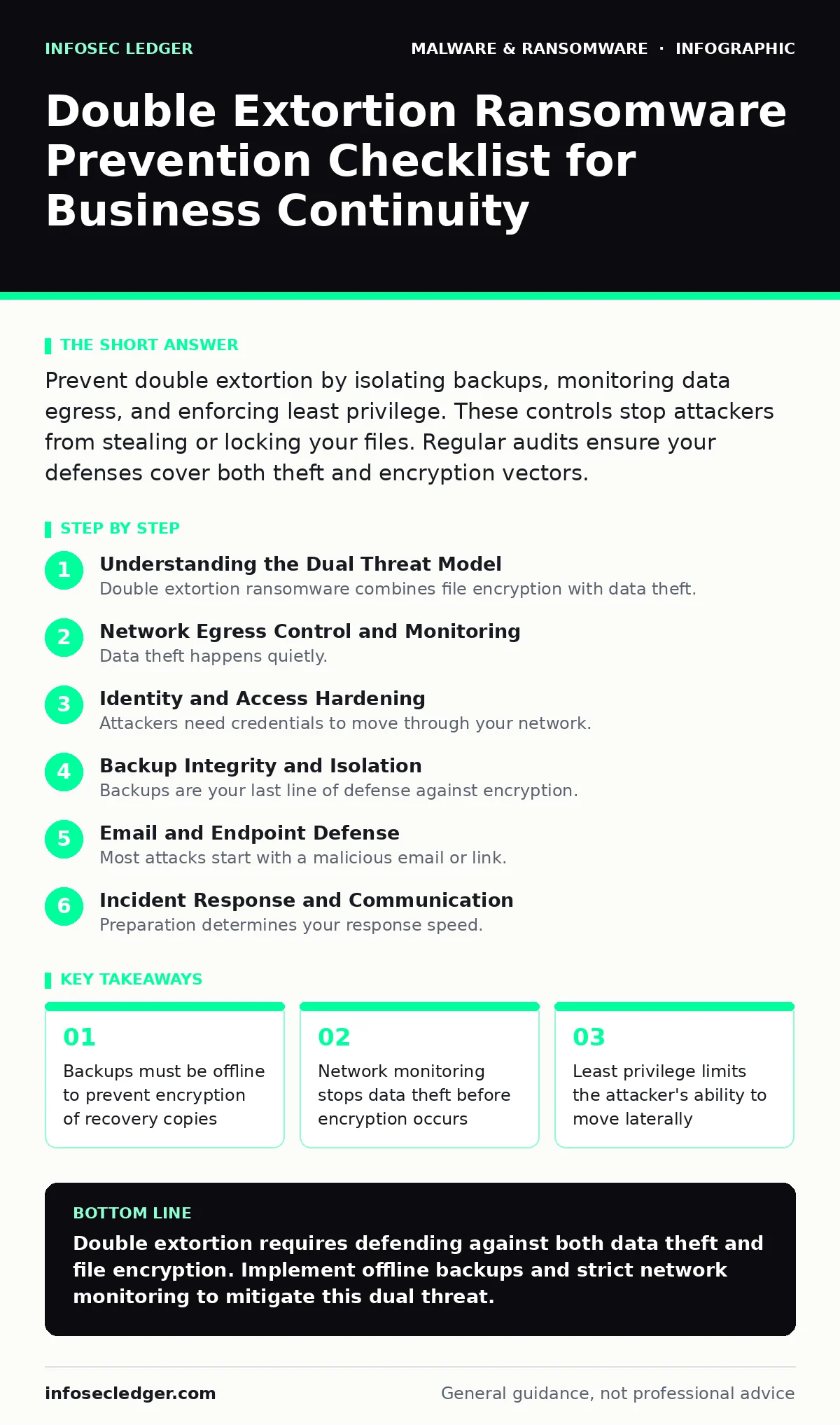
Prevent double extortion by isolating backups, monitoring data egress, and enforcing least privilege. These controls stop attackers from stealing or locking your files. Regular audits ensure your defenses cover both theft and encryption vectors.
Understanding the Dual Threat Model
Double extortion ransomware combines file encryption with data theft. Attackers steal sensitive information before locking your systems. They then demand payment to restore access and delete the stolen data. This approach removes the safety net of backups. You cannot simply restore files if your customer data is public. The threat shifts from availability to confidentiality.
Standard ransomware defenses often fail here. Restoring from backup does not stop the leak. You must defend against data exfiltration as much as encryption. This requires a different mindset for your security operations.
Network Egress Control and Monitoring
Data theft happens quietly. Attackers send stolen files to their servers over the internet. You must monitor outbound traffic to detect this activity. Unusual data volumes or connections to new destinations are red flags.
- Implement strict firewall rules: Block unnecessary outbound connections to limit exfiltration paths.
- Enable DNS logging: Record all domain lookups to identify command-and-control channels.
- Monitor bandwidth spikes: Detect large data transfers that indicate bulk theft.
- Use data loss prevention tools: Identify and block sensitive data leaving the network.
Imagine an attacker who has already encrypted your files. If they can still send data out, they will. Blocking egress stops the second part of the extortion. This control is often overlooked but vital for preventing public leaks.
Identity and Access Hardening
Attackers need credentials to move through your network. They steal data by accessing shared drives and databases. Weak authentication allows them to impersonate legitimate users. You must limit what each account can do.
- Enforce multi-factor authentication: Prevent login with stolen passwords alone.
- Apply least privilege principles: Give users only the access they strictly need.
- Disable legacy protocols: Turn off SMBv1 and other outdated protocols that facilitate lateral movement.
- Audit admin accounts: Regularly review who has elevated rights and remove unnecessary access.
See our guide on the ransomware attack chain to understand how initial access leads to full compromise. Limiting identity scope breaks this chain. If an attacker cannot escalate privileges, they cannot reach your most sensitive data. This reduces the value of any breach.
Backup Integrity and Isolation
Backups are your last line of defense against encryption. However, connected backups are vulnerable. Attackers will find and encrypt them too. You need backups that are invisible to the live network.
- Maintain offline copies: Store backups on disconnected media to prevent remote encryption.
- Test restore procedures: Verify you can recover data quickly and completely.
- Use immutable storage: Prevent backups from being deleted or modified for a set period.
- Segment backup networks: Isolate backup servers from the main corporate network.
Compare this to rootkits, which hide deep in systems. Offline backups remain safe because they are not connected. If you cannot access your backups during an incident, they are useless. Regular testing ensures they work when you need them most.
Email and Endpoint Defense
Most attacks start with a malicious email or link. Users click, and malware installs. You must stop the initial infection. Endpoint detection and response tools monitor for suspicious behavior.
- Filter phishing emails: Block messages that attempt to trick users into clicking links.
- Deploy endpoint detection: Monitor devices for unusual processes or file changes.
- Disable macro execution: Prevent Office documents from running hidden scripts.
- Patch software regularly: Close known vulnerabilities that attackers exploit for initial access.
Consider how logic bombs trigger at specific times. Your endpoint tools must detect the installation phase. Early detection allows you to isolate the infected device before it spreads. This limits the scope of the attack significantly.
See also: SEO Poisoning Myths: Why Your Site Is Not the Only Target · Malicious Mobile Apps: Debunking 6 Common Security Myths
Incident Response and Communication
Preparation determines your response speed. When an attack occurs, you must act quickly. A clear plan reduces panic and decision fatigue. You need to know who to call and what to do.
- Draft a response plan: Define steps for isolation, assessment, and recovery.
- Identify legal counsel: Prepare for regulatory notification requirements.
- Prepare customer notifications: Have templates ready for data breach disclosure.
- Conduct tabletop exercises: Practice your response to identify gaps in the plan.
Review our article on file hashes in malware detection to understand how to identify known threats. During an incident, speed is critical. Isolating affected systems prevents further damage. Clear communication maintains trust with customers and partners.
Continuous Validation and Improvement
Security is not a one-time task. Attackers change their tactics constantly. You must update your defenses regularly. Assume your perimeter has been breached.
- Perform red team tests: Simulate attacks to find weaknesses in your defenses.
- Review logs daily: Look for anomalies that indicate compromise.
- Update security policies: Reflect new threats and business changes in your rules.
- Train staff continuously: Educate employees on recognizing social engineering attempts.
Imagine a scenario where scareware tricks a user into installing malware. Your continuous monitoring catches the behavior. Regular validation ensures your controls work as intended. This proactive approach reduces risk over time.
Key takeaways
- Backups must be offline to prevent encryption of recovery copies
- Network monitoring stops data theft before encryption occurs
- Least privilege limits the attacker's ability to move laterally
Double extortion requires defending against both data theft and file encryption. Implement offline backups and strict network monitoring to mitigate this dual threat.
Frequently asked questions
Can antivirus software stop double extortion ransomware?
Antivirus helps detect known malware but may miss new variants. You need behavioral monitoring and network controls to stop data theft and encryption effectively.
How do I know if data has been exfiltrated?
Monitor outbound traffic for unusual volumes or destinations. DNS logs and firewall alerts can indicate data leaving your network without authorization.
Is paying the ransom ever recommended?
No. Payment does not guarantee data deletion or recovery. It also encourages further attacks and may violate legal or regulatory requirements.
What is the first step in a double extortion response?
Isolate affected systems from the network immediately. This stops further encryption and prevents additional data from being stolen by the attackers.
How this guide was produced: written by the InfoSec Ledger editorial team with AI assistance, checked against the public references listed below, and reviewed when the facts change. See our editorial policy or report an error.